
Tennis Accumulator Tips: Building Profitable Accas Across Tournaments
 Available in US
html
I have a rule about tennis accumulators that I break about twice a year: never combine more than four legs. The rule exists because I have tracked every accumulator I have placed since 2016, and the data is unambiguous. Four legs is the ceiling where expected value holds up against the compounding probability of an upset killing the ticket. Beyond four, you are paying an entertainment tax, not placing a strategic bet.
Tennis accounts for roughly 8% of all sports betting turnover in the UK. Accumulators punch above their weight within that 8% because the odds stack attractively — four match winners at 1/3 each combine to around 2.16/1, which feels like a legitimate return for what seems like four near-certainties. The problem, of course, is that none of them are certainties.
Contents
How to Construct a Tennis Accumulator That Holds Together
The first decision is selection type. Match-winner legs are the default for most punters, but they are not always the best building blocks. A 1/5 favourite adds almost nothing to your accumulator odds while carrying the same upset risk as any other leg. I learned this the hard way during the 2018 French Open when three “certain” favourites all lost on the same day, and a five-leg acca that looked bulletproof evaporated before the fourth match even started.
The construction method I use now starts with filtering: I identify matches where I have a genuine analytical view, not just a hunch based on rankings. If I cannot articulate in one sentence why I expect a specific outcome in a specific match, that match does not go into the accumulator. This filter alone cuts my potential selections by about 60%, which is the point — an acca built on three strong opinions is worth more than one built on six weak ones.

Tournament phase matters for selection timing. Early rounds of major tournaments are where the biggest ranking mismatches occur, and they produce the highest win rates for favourites. But those early-round prices are also the shortest, which means they contribute the least to your combined odds. Mid-tournament rounds — quarter-finals, semi-finals — offer better prices because the remaining players are closer in quality, and that is where your analytical edge (if you have one) translates into odds that actually move your return.
The mechanics of building the slip are simple: add each selection, review the combined odds and potential return, and critically — check for correlation. More on that below. If you are combining tennis odds across different bookmakers to find the best price on each leg, some operators allow you to mix and match; others require all legs to be placed with them. Know which system you are using before you build.
Correlation Risk and Leg Selection in Tennis
Correlation is the silent killer of tennis accumulators, and almost nobody talks about it. Two legs are correlated when the outcome of one influences the probability of the other. In football, this is obvious — you would not combine “Team A to win” with “under 0.5 goals” because they pull in opposite directions. In tennis, the correlations are subtler but just as dangerous.
The most common correlation trap: combining two legs from the same half of a draw. If Player A and Player B are both in your accumulator and they are scheduled to meet in the quarter-finals, one of them will necessarily lose. Your acca dies in the quarter-finals by design. Always check the draw before combining selections from the same tournament.

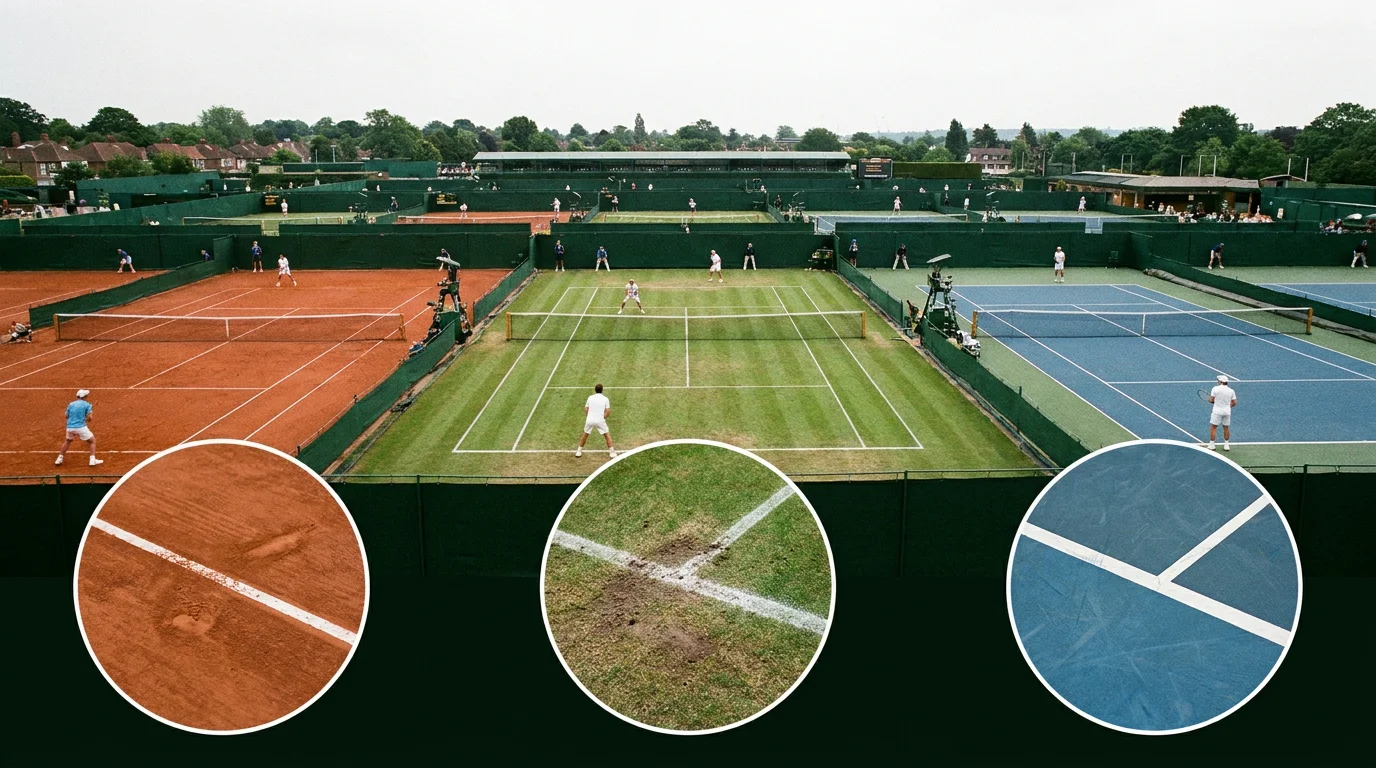
Surface correlation is less obvious but equally important. Clay-court tournaments produce roughly 15% more upsets than grass events. If you build an accumulator entirely from clay-court matches, you are compounding a higher upset probability across every leg. Mixing surfaces — one clay match, one hard-court match, one grass match — diversifies that risk, though it also means you need analytical depth across all three surfaces rather than specialising in one.
The correlation that most punters miss entirely is scheduling. Players competing in back-to-back matches on the same day — common at smaller ATP 250 events — carry fatigue risk that compounds if they are both in your acca. A three-set semi-final in the afternoon affects performance in the evening final. If both your semi-final favourite and your final favourite are the same player, you have a hidden correlation: the first result directly affects the second.
Accumulator Boosts and Insurance: What Is Actually Useful
Every major UK bookmaker offers accumulator boosts — percentage increases on your winnings if all legs land. The headline numbers look generous: 10% boost on a four-fold, 25% on a six-fold, sometimes higher. The reality is that these boosts are calibrated so the operator still holds an edge after the bonus is applied. A 10% boost on a four-fold does not come close to compensating for the overround built into each individual leg.
That said, boosts are free money when they land. The question is whether they should influence your construction decisions. My answer is no. Never add a fifth leg to an accumulator just to qualify for a higher boost tier. The marginal increase in the boost percentage is always smaller than the marginal decrease in your probability of winning. The maths on this is unambiguous.

Accumulator insurance — where the operator refunds your stake as a free bet if exactly one leg lets you down — is more useful in practice. It effectively converts your accumulator from an all-or-nothing bet into one with a safety net. The catch is that the refund comes as a free bet with wagering requirements, not as cash. Depending on those requirements, the actual value of the insurance might be 50-70% of face value. Still worth having, but not the full refund it appears to be.

The honest assessment: accumulators are a high-variance product, and no amount of boosts or insurance changes the underlying maths. If you build them with analytical rigour, limit the legs, avoid correlated selections, and treat the boosts as a bonus rather than a reason to bet — they can be a profitable part of a broader tennis betting approach. If you build them for excitement and hope, they are an expensive hobby.
Articles
Written by the editors at bettennisonline.com.
