
Live Tennis Betting: Why In-Play Dominates and How to Read Momentum in Real Time
 Available in US
html
The moment that rewired how I think about tennis betting happened at the 2018 US Open. I was watching a fourth-round match on a second screen while tracking odds on my laptop. The favourite was cruising — up a set and a break — and then dropped serve, dropped another, and suddenly the second set was gone. In the space of twelve minutes, the match-winner price swung from 1.12 to 1.85. The live market had repriced the entire contest in real time, and anyone paying attention had a window to act that pre-match bettors never see.
That experience was not unusual. It was tennis. In-play betting and this sport are inseparable, and the numbers confirm what anyone who has watched a tennis match already suspects: the action happens live, not before the first ball is struck. Ninety percent of tennis bets placed on Entain’s platforms are in-play — the highest live-betting share of any sport the operator covers. This is not a niche habit. It is how the tennis market functions.
After more than a decade of working with live tennis markets, I have developed a set of principles for reading momentum, interpreting live odds shifts, and managing positions mid-match. This guide lays out those principles, from the structural reasons tennis dominates in-play betting to the practical tools you need to trade a match in real time.
Contents
Why Tennis Commands the Highest In-Play Share of Any Sport
Football gets the volume. Horse racing gets the tradition. But no sport is built for live betting the way tennis is. That 90% in-play figure from Entain is not an anomaly — it reflects a structural reality that no other sport can match.
The first reason is the scoring format itself. A tennis match is a nested sequence of discrete events: points build into games, games build into sets, sets build into a match. Each of those levels creates a natural settlement point and a fresh market opportunity. A football match has a continuous clock and occasional goals; a tennis match has hundreds of individually resolvable micro-events per hour. Every point changes the state of the match, and every state change gives the market something new to price.
The second reason is the absence of draws. Tennis produces a winner. Every match ends with a result, and every live position eventually resolves. This binary structure — one player wins, one loses — makes in-play pricing cleaner than in sports where a draw is a significant outcome. Bookmakers can model two-way markets in real time with more confidence, which means tighter spreads and more frequent price updates.
The third reason is pacing. A typical tennis point lasts between four and ten seconds, with roughly twenty seconds between points. That rhythm creates a continuous flow of information without overwhelming the bettor. You have time to assess, decide, and act between points — something that is much harder in, say, basketball, where the pace of play often outstrips the speed of live-market updates.
Tennis is the second most popular sport for in-play betting in the UK after football, but it leads all sports in the proportion of bets placed live. Globally, live betting accounted for 62.35% of the online sports betting market in 2026 — and tennis sits well above that average. The infrastructure behind this is worth noting: Sportradar’s partnership with the ATP, driven by technologies like computer vision and artificial intelligence, delivers point-level data to operators within seconds. Sportradar CEO Carsten Koerl has described this as a “truly collaborative partnership” aimed at building real-time products that serve both fans and bettors. Without that data pipeline, the 90% in-play figure would be structurally impossible — the markets could not reprice quickly enough to keep pace with the sport.
All of this means that if you are betting on tennis and not engaging with the live market, you are ignoring where the vast majority of the action — and the opportunity — actually lives.
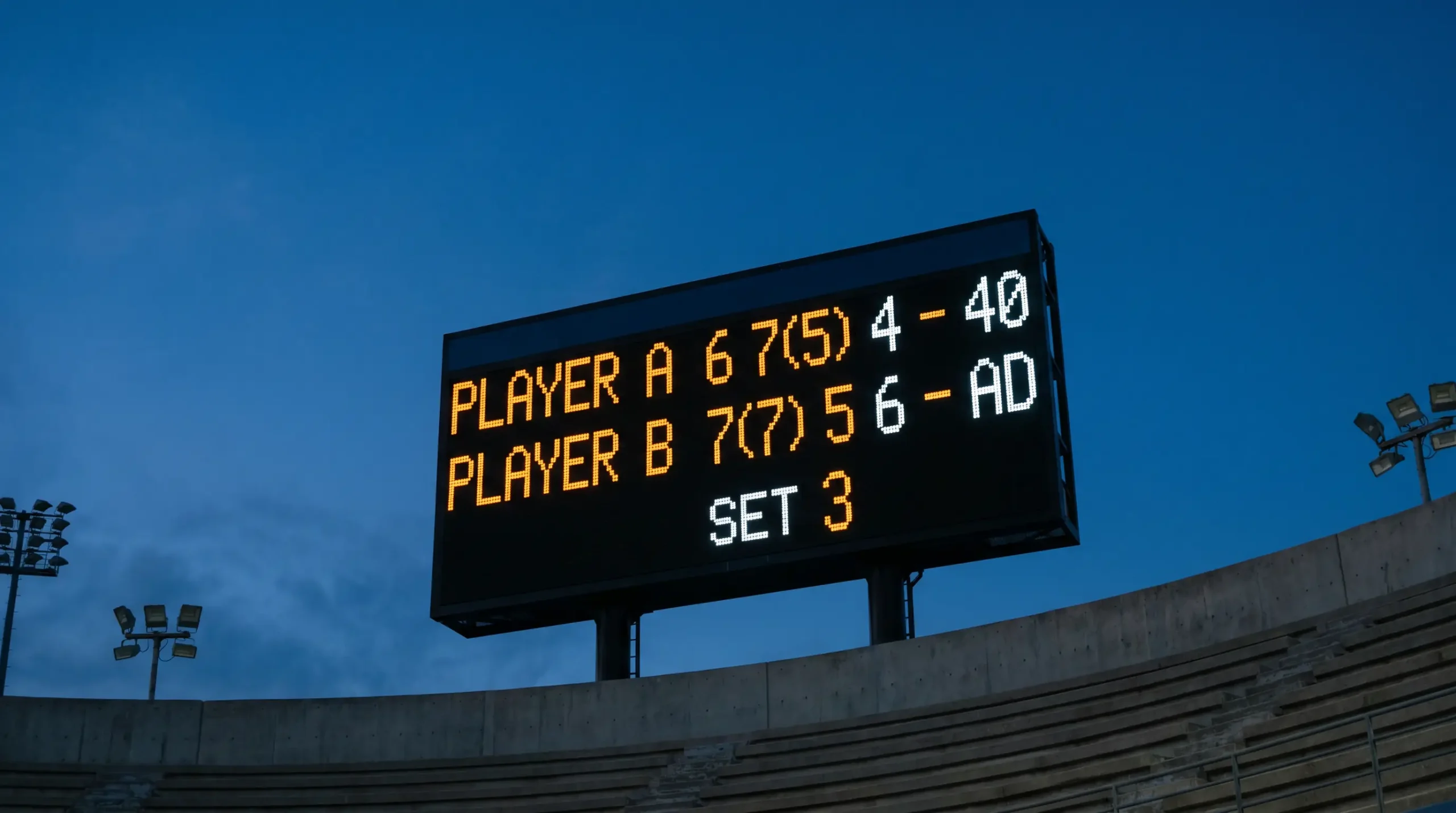
In-Play Markets and the Micro-Events That Drive Them
Most people think of live tennis betting as “match winner during the match.” That is one market. It is not even the most interesting one. The real depth of in-play tennis lies in the micro-event markets that let you bet on the granular structure of a match while it is happening.
Next-game winner is the entry point. The market reopens after each game and lets you back either player to win the upcoming game. Service games are priced shorter for the server (reflecting the serve advantage), and break-point games are priced accordingly. The pricing here is fast and reactive — if a server has just been broken, the next-game-winner odds recalibrate instantly to reflect the shift in momentum and the new game score.
Next-set winner operates one level up. This market is particularly useful when a match splits sets and you have a view on which player handles the pressure of a deciding set better. The odds here are influenced by the current set score, the players’ records in deciders, and — critically — the physical state of each player. A five-set match at the Australian Open in 35-degree heat creates a very different next-set-winner price in the fourth set than a best-of-three on a cool evening in London.
Point-level markets exist on some platforms for high-profile matches, letting you bet on the outcome of individual points. These markets are extremely fast-moving and typically carry a higher margin, but they create opportunities for bettors who can read patterns within a service game — for instance, a server who consistently loses the first point of the game but holds comfortably thereafter.
Sixty percent of tennis bets on Entain’s platforms are placed on men’s matches, partly because best-of-five-set formats at Grand Slams generate longer matches with more micro-events and more in-play market opportunities. A men’s Grand Slam match lasting four sets might produce 150 to 200 individual market events; a women’s best-of-three typically produces 80 to 120. More events mean more decision points and more chances to find a price that does not reflect what you are watching on court.

The practical implication is that your in-play strategy should be calibrated to the match format. Best-of-five gives you more runway to recover from a bad early position and more opportunities to enter the market at favourable prices after momentum shifts. Best-of-three is faster, more volatile, and less forgiving of mistimed entries.
Reading Momentum: Breaks, Runs and Turning Points
I was sitting courtside at Queen’s Club a few years ago, watching a match that looked entirely one-sided on paper. The favourite was a set and 3-1 up. Then the underdog changed something — not his tactics, but his energy. He started winning the first point of his service games, took an extra second between serves, and the favourite’s body language shifted. Within twenty minutes, the set was level. The live odds, which had been 1.08, jumped to 1.35. Momentum had turned, and it was visible before the scoreline reflected it.
Momentum in tennis is real, measurable, and tradeable — but it is also widely misunderstood. The most common mistake is treating momentum as mystical. It is not. Momentum is a cluster of correlated positive outcomes that alters the probability distribution for subsequent points. A break of serve does not happen in isolation; it typically follows a sequence where the returning player wins two or three points in a row, and that sequence changes the psychological and tactical dynamics of the next game.
The key momentum indicators I track during live matches are: break of serve (the most obvious and highest-impact event — a single break in a tight set can swing match-winner odds by 15-25%), consecutive points won on return (three or more return points in a row signals that the returning player has found a read on the serve pattern), first-serve percentage collapse (if a server’s first-serve rate drops below 55% mid-set, the probability of a break increases sharply), and unforced error clusters (three or more unforced errors in two consecutive games often precede a turning point).
Ninety-five percent of online gambling in the UK happens from home, and 76% of the 18-24 age group use mobile phones for betting. That means most live tennis bettors are watching a stream or a point-by-point tracker on the same device they are using to place bets. The information asymmetry that once existed between courtside observers and remote bettors has largely collapsed — but a gap remains between those who watch passively and those who actively track the indicators listed above. Watching a match is not the same as reading it.
One nuance that took me years to learn: momentum in tennis is not linear. It clusters, pauses, and sometimes reverses without any visible cause. A player who breaks serve to lead 4-2 in the second set might immediately get broken back because the psychological pressure of serving for a commanding lead triggers a different kind of anxiety. I have seen this pattern hundreds of times. The market often overreacts to the initial break and underprices the break-back risk — which creates a window for the attentive live bettor.

How Live Odds Move — and What the Shifts Mean
Live tennis odds do not move smoothly. They jump. A single break of serve in the first set of a competitive match can shift the match-winner price from 1.80 to 1.40 in the time it takes to play four points. Understanding the size, speed, and direction of these jumps is essential for anyone trading in-play.
The largest single-event odds movements in tennis come from three scenarios: a break of serve in a tight set (particularly the first set, which sets the tone for pricing in subsequent sets), a set being won by the underdog (the market dramatically recalculates when a player who was expected to lose takes the first set), and a tie-break (the binary, high-variance nature of tie-breaks produces the sharpest swings per point in all of tennis betting).
Smaller but equally important movements come from within-game patterns. If the server falls to 0-30, the match-winner odds nudge in the returner’s direction — not dramatically, but enough to create micro-opportunities for bettors who are watching the match and anticipating the scoreline rather than reacting to it. The skill here is predictive positioning: placing a bet before the event that triggers the odds movement, based on your read of the pattern unfolding on court.
A common trap is chasing odds after a big movement. The player who just got broken is now priced at 2.50, up from 1.80 — and the instinct is to back them because “they were the favourite for a reason.” Sometimes that logic holds. But the market has already incorporated the break into the new price. The question is not whether the player is good; it is whether 2.50 accurately reflects their probability of winning from their current position. Often it does, because modern pricing models are fast and accurate. The value play after a big odds shift is not to blindly back the drifting player but to assess whether the shift has overshot — whether the market has overreacted to the immediate event and underweighted the player’s structural advantages (serve quality, physical fitness, experience in recovery situations).
I keep a mental model of what I call “equilibrium price” for each match — the price the market would settle at if both players were serving comfortably with no breaks. When the actual price diverges significantly from that equilibrium after a momentum event, it is worth asking whether the divergence is justified or an overreaction. That question is the foundation of live tennis trading.

Platform Features That Matter for In-Play Tennis
The platform you use for live tennis betting is not a neutral container. It is an active variable that affects your execution speed, information flow, and ultimately your results. After testing nearly every major UK platform for in-play tennis, I have a clear list of features that separate functional platforms from frustrating ones.
Speed of bet acceptance is paramount. In a sport where a single point can shift the odds by 5-10%, a delay of three or four seconds between clicking “place bet” and receiving confirmation can mean the price you wanted has already gone. The best platforms for in-play tennis accept bets within one to two seconds on mainstream matches. If you are consistently seeing “odds have changed” rejections, the platform’s latency is costing you money.
Live data visualisation matters more than live streaming for betting purposes. A point-by-point tracker that shows serve speed, placement, and game-by-game statistics gives you more actionable information than a video stream with a fifteen-second delay. Some platforms offer both; prioritise the data feed. The ATP’s full adoption of Hawk-Eye Live electronic line-calling across all tournaments from 2026 has improved the accuracy and speed of these data feeds, giving platforms better raw material to work with.
Market depth during live play varies enormously between platforms. Some operators offer only match-winner and set-winner in-play; others provide game-level markets, point-level markets, and dynamic handicaps that update throughout the match. For serious in-play betting, you need access to at least next-game-winner and running game totals in addition to the match-winner market.
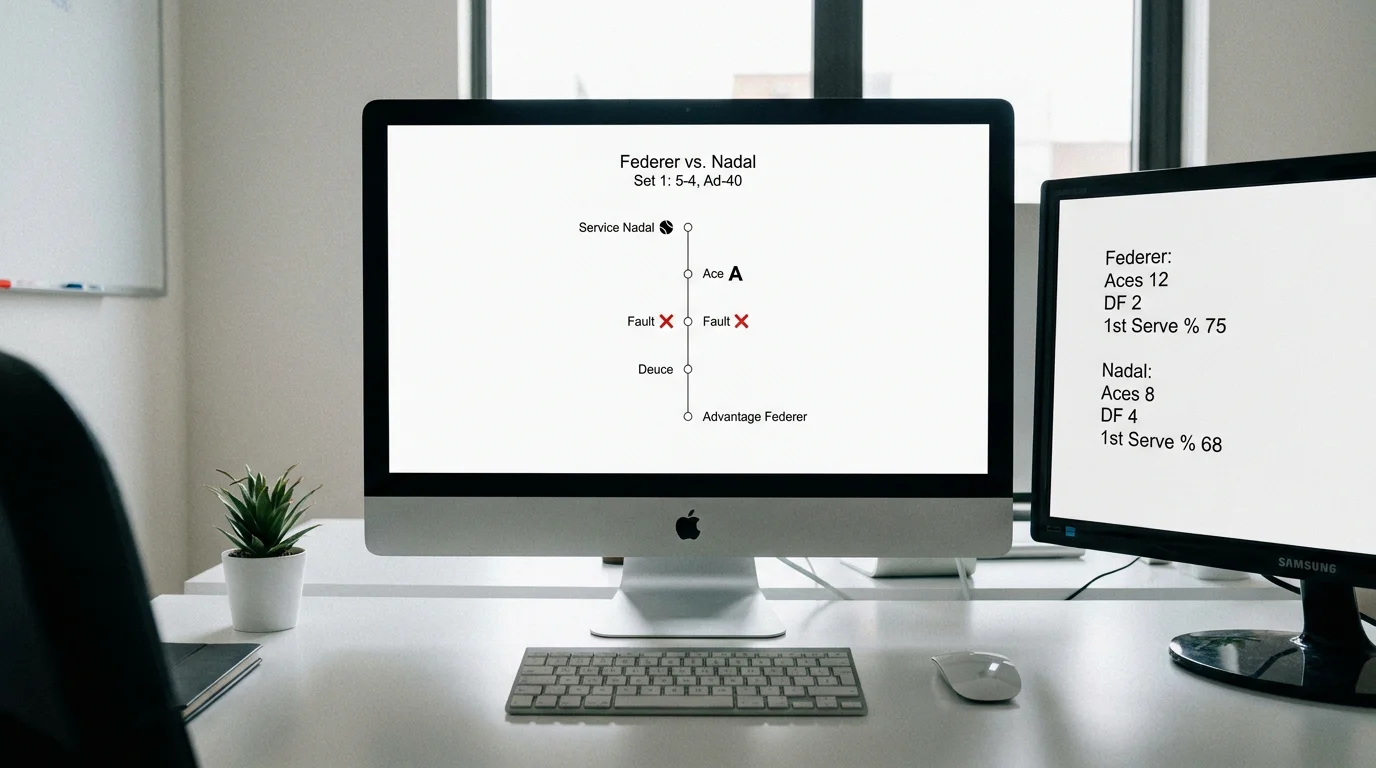
Cash-out functionality is a feature you will use more in tennis than in almost any other sport, because the frequency of momentum shifts creates frequent decision points about whether to hold or exit a position. The speed and fairness of the cash-out price matters — some platforms offer cash-out prices that trail the current market by a significant margin, effectively taxing you for the privilege of closing your bet early.
Managing Risk When the Match Is Already Under Way
Pre-match betting lets you set your stake and walk away. Live betting does not. The moment you enter a position mid-match, you are managing an active risk that changes with every point. This is what makes in-play tennis both more profitable and more dangerous than pre-match wagering — the information is richer, but so is the temptation to overtrade.
The first rule of in-play risk management is to define your exit conditions before you enter the position. I decide in advance: “I am backing this player at 2.20 because I believe the market has overreacted to the first-set loss. If they go down a break in the second set as well, I exit. If they level the match, I reassess.” Without pre-set exit conditions, you are making decisions under emotional pressure — and emotional decisions in live markets are almost always bad.
Stake sizing in live markets should be smaller than in pre-match markets as a default. The volatility is higher, the decision speed is faster, and the opportunity to place multiple bets within a single match means your total exposure can escalate quickly. I use a maximum of 1.5% of my bankroll per in-play bet, compared to 2-3% for pre-match positions. This gives me room to take two or three positions in a match without overexposing myself to a single outcome.
Cash-out is a tool, not a panic button. Used well, it lets you lock in profit when the match has moved in your favour but the remaining uncertainty is high (for instance, you backed the underdog and they have won the first set — the profit is real, but two sets remain). Used badly, it becomes a mechanism for crystallising losses early because you cannot handle watching the match. The full framework for when to cash out a tennis bet and when to hold deserves its own analysis, but the core principle is: cash out only when the expected value of holding is lower than the cash-out offer, not because you are nervous.
A specific risk unique to live tennis is the retirement scenario. A player picks up an injury mid-match, retires, and your bet is either voided or settled depending on the bookmaker’s rules and how many sets have been completed. This is not a theoretical risk — retirements happen regularly, particularly in the later rounds of Grand Slams and during the grinding hard-court swing in summer. Checking the retirement policy on your platform before placing a live bet is a basic but often overlooked step.
The final risk to manage is simply the temptation to bet every match you watch. Live tennis is engaging, the markets are always open, and the feeling of “reading the match correctly” creates a dopamine feedback loop that encourages overtrading. The discipline to watch a match without betting — to acknowledge that no value exists in the current prices — is as important as the discipline to act when value does appear.

Frequently Asked Questions About Live Tennis Betting
Articles
Prepared by the bettennisonline.com editorial staff.
