
Tennis Grand Slam Betting: Comparing All Four Majors for Market Depth and Opportunity
 Available in US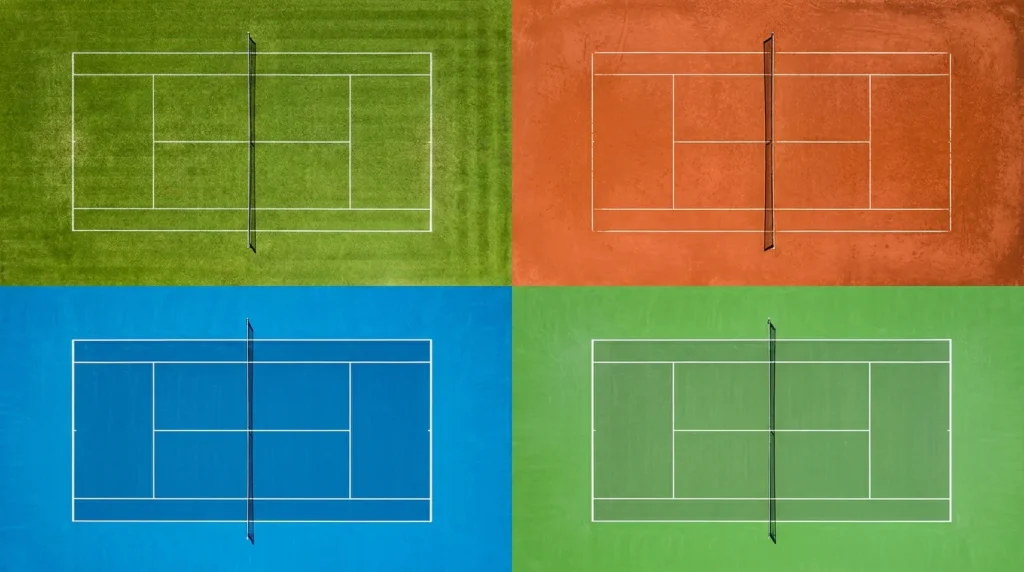
html
I used to treat the four Grand Slams as interchangeable — same format, same prestige, similar odds. It took about two years of serious tennis betting before I understood how wrong that was. Each Slam has a distinct market personality shaped by its surface, timing, time zone, and crowd culture. Treating them as one category is like treating Premier League and Championship football as the same product because both use a round ball.
The differences between the four are not marginal. They affect which markets carry value, when to bet, what analytical frameworks apply, and how much liquidity you can access. Understanding these profiles — and planning your betting calendar around them — is one of the most practical edges available to UK tennis bettors.
Contents
Four Surfaces, Four Calendars, Four Market Profiles
The Australian Open (January, hard court) opens the season with maximum uncertainty and a time zone that challenges UK bettors. Roland-Garros (May-June, clay) produces the highest upset rates and longest matches. Wimbledon (June-July, grass) has the most efficient headline markets and the shortest matches. The US Open (August-September, hard court) delivers the highest overall betting volume thanks to night sessions and favourable UK timing.
Wimbledon’s record 2026 prize fund of £53.55 million — with £3 million for each singles champion — reflects its commercial supremacy, but betting supremacy belongs to the US Open. Entain’s data identifies Flushing Meadows as the most popular Slam for wagering, with the French Open outperforming Wimbledon because clay-court matches generate more in-play betting events per hour. That ranking — US Open, French Open, Wimbledon, Australian Open in descending volume — should inform how you allocate your betting capital and attention across the calendar.

Khalid Ali of the IBIA noted that in Q1 2026, football and tennis remained the most reported sports for suspicious betting activity, though their combined alert numbers were down 14% compared to Q4 2026. For Grand Slam bettors, the integrity environment is strongest at the majors because the monitoring infrastructure is deepest. The quarterly fluctuations in alert volumes reflect detection capability rather than risk levels, which means the majors remain the safest betting environment in tennis.
The surface breakdown creates specific analytical demands. At the Australian Open, you need hard-court data adjusted for heat and season-opening form uncertainty. At Roland-Garros, clay-specialist identification and endurance modelling are primary. Wimbledon requires serve analytics and an understanding of grass-specific upset dynamics. The US Open demands day-vs-night session analysis and late-season fatigue assessment. If you are serious about ATP tour betting, the Grand Slams are where the most sophisticated analysis meets the most liquid markets.
Market Depth and Liquidity Across the Slams
Market depth is not uniform across the four majors. Wimbledon and the US Open have the deepest markets in absolute terms because they attract the most recreational and institutional money. You can get significant stakes matched on outright, match-winner, and in-play markets without moving the price. Roland-Garros has strong depth on the headline markets but thinner liquidity on secondary markets like individual-set totals. The Australian Open, despite its attendance record, has the thinnest markets relative to its stature because the time zone limits UK and European participation.
Sportradar’s multi-year renewal for Wimbledon’s official data and audiovisual betting rights — giving them coverage of three out of four Grand Slams — ensures that the data infrastructure behind live odds at three of the four majors is consistent and high-quality. The practical implication: in-play odds at Wimbledon, the US Open, and the event covered by Sportradar’s other deals update faster and more reliably than at tournaments with different data providers. This matters if you are trading live positions, because data latency is the difference between getting your price and watching it move past you.
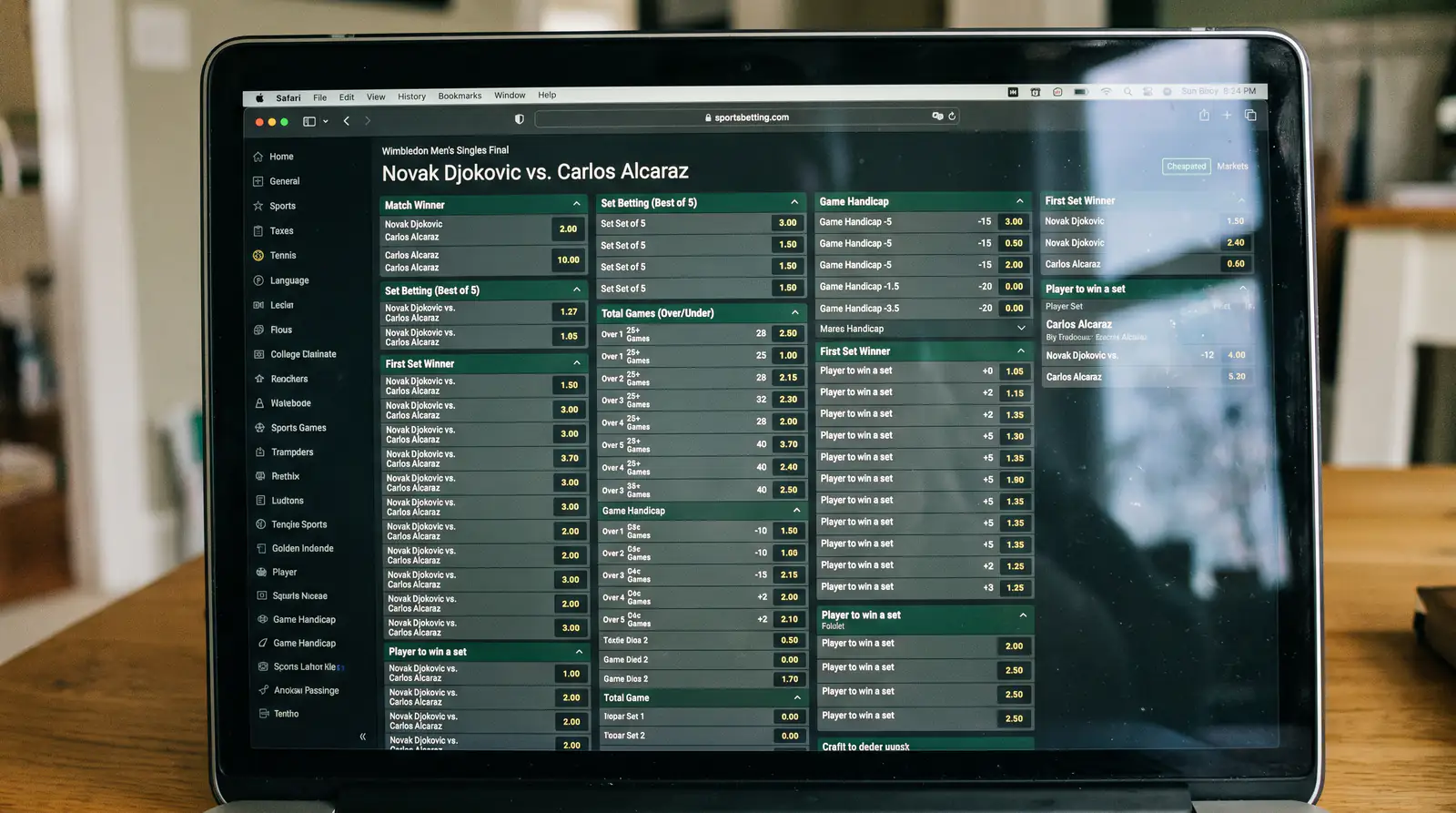
For secondary markets — handicaps, totals, set betting, props — the depth drops off sharply outside the main draw rounds. First-round matches between a top seed and a qualifier might have 15-20 available markets. By the quarter-finals, that number can exceed 40 on major UK bookmaker platforms. Plan your market selection around this: if you want to bet set-score markets, focus on the second week when depth and pricing are best.
Using the Slam Calendar to Plan Betting Activity
The four Grand Slams are not evenly spaced. The Australian Open in January is followed by a four-month gap before Roland-Garros in late May. Then just three weeks separate Roland-Garros from Wimbledon. The US Open follows in late August, leaving a four-month gap before the cycle restarts.
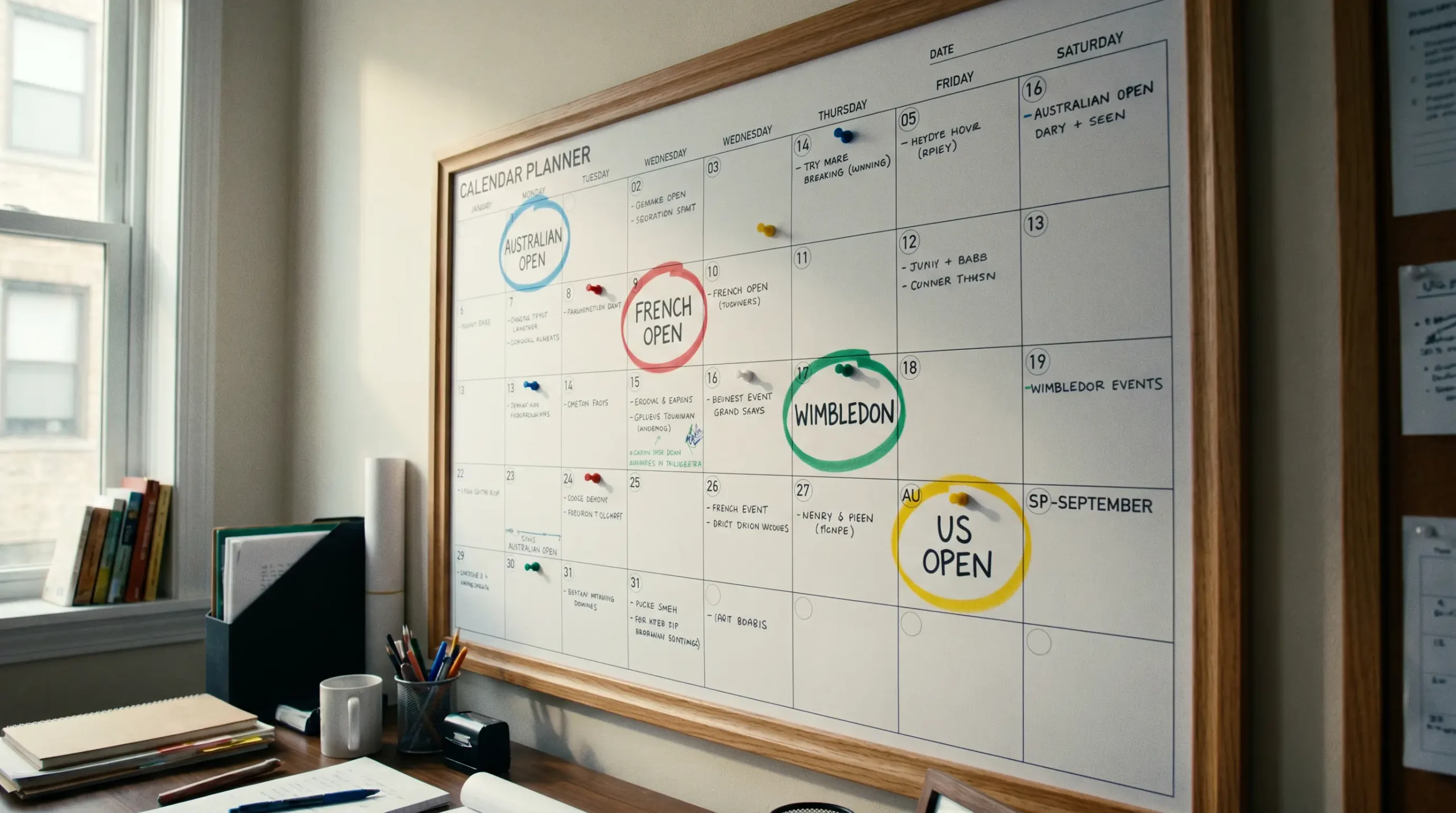
That uneven spacing has tactical implications. The Roland-Garros-to-Wimbledon transition is the most extreme surface switch on the tour: clay to grass in less than three weeks. Players who reach the latter stages of Roland-Garros have almost no time to adjust to grass, which creates a specific mispricing opportunity at Wimbledon. A player who lost in the French Open final might be overpriced at Wimbledon because the market assumes form carries across surfaces, when in fact the surface switch and compressed recovery time work against them. Conversely, a player who exited Roland-Garros early — in the first or second round — arrives at Wimbledon fresher and with more grass-court preparation time, which the market sometimes undervalues.

The Australian Open’s isolation at the start of the calendar makes it the most standalone event. Futures bettors sometimes use the Australian Open result as a recalibration point: if a player over- or underperforms relative to their futures odds, the post-Australian Open window is when those futures prices are most likely to misprice the rest of the season.
My own calendar is built around these rhythms. I increase my betting activity and capital allocation in the two weeks surrounding each Grand Slam, reduce it during the intervening smaller events, and use the off-season (November-December) for analysis rather than betting. The Slams are where the liquidity, the data, and the market depth combine to create the best risk-adjusted opportunities. Everything else is supplementary.

Articles
Written by the editors at bettennisonline.com.
