
Tennis Betting Exchanges UK: How Peer-to-Peer Markets Differ From Bookmakers
 Available in US
html
The first time I used a betting exchange for tennis was during Wimbledon 2015. I backed a player to win the first set, watched him go 4-1 up, then laid him at shorter odds to lock in a profit regardless of the outcome. The match had not even reached the halfway point of the first set, and my position was already green. That moment — the realisation that I did not need the bet to win to make money — fundamentally changed how I thought about tennis markets.
Exchanges account for a smaller slice of the UK market than traditional bookmakers, but for tennis specifically, they solve problems that bookmakers cannot. The ability to bet against an outcome, trade positions in-play, and access odds set by other bettors rather than a pricing desk makes exchanges a different instrument entirely — not better or worse, but different in ways that matter for specific strategies.
Contents
Back, Lay and Commission: Exchange Mechanics Explained
An exchange is a marketplace where two bettors take opposite sides of the same bet. When you “back” a player at 2.50, someone else is “laying” that player — effectively betting against them at the same price. The exchange takes a commission on your net winnings, typically between 2% and 5%, rather than building a margin into the odds themselves.
This is the fundamental difference from a bookmaker. A bookmaker sets odds that include an overround — a built-in margin that guarantees the house profits regardless of the outcome. On a two-player tennis match, a bookmaker might price both players so the combined implied probability exceeds 105-108%. An exchange has no overround; the odds reflect the genuine meeting point of supply and demand. The trade-off is that you pay commission on winning bets instead.

Laying is the concept most newcomers struggle with. When you lay a player at 2.50 for a £10 stake, you are accepting a £10 bet from another user at those odds. If the player loses, you collect the £10 stake. If the player wins, you pay out £15 (the £10 stake multiplied by the odds minus one). Your maximum liability on a lay bet is always (odds – 1) x stake, which means laying at long odds carries serious risk. Laying a 10/1 shot exposes you to nine times your opponent’s stake.
The commission structure varies by operator and by your betting volume. Standard commission is 5% of net market winnings — meaning if you win £100 on one market but lose £40 on another, you pay 5% of the £60 net, which is £3. High-volume bettors negotiate lower rates, sometimes down to 2%. For tennis, where you might trade in and out of a position multiple times during a single match, the commission rate directly affects the viability of your strategy. A 3% difference in commission across hundreds of trades compounds into a significant sum. The detail of how exchange mechanics compare to spread betting structures is worth understanding if you are evaluating which trading approach suits your risk profile.

Why Tennis Suits Exchange Betting Particularly Well
Ninety percent of tennis bets on Entain’s platforms are placed in-play — the highest live-betting share of any sport.
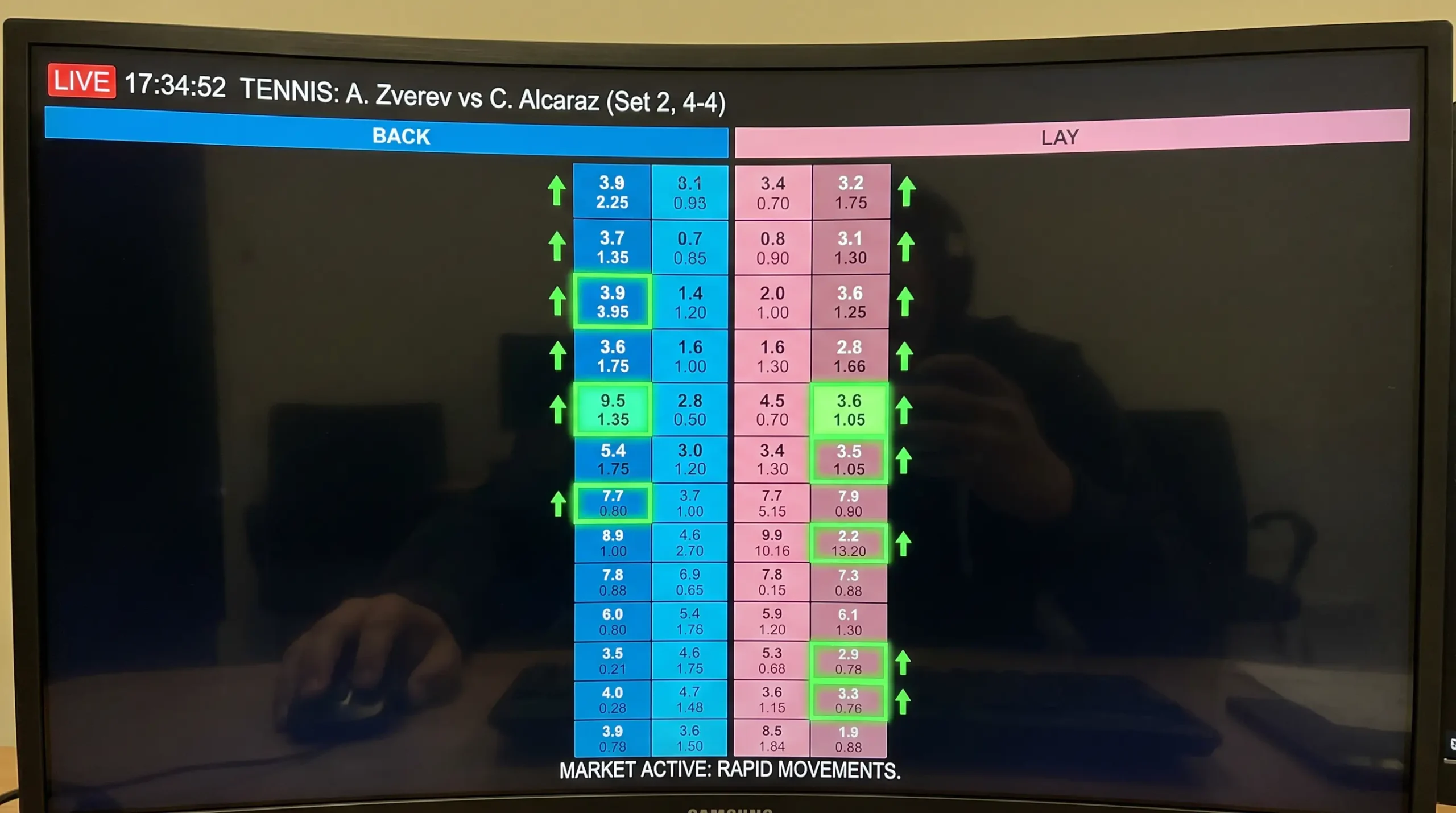
 Exchanges thrive on in-play activity because every point in a tennis match changes the odds, and every odds change is a potential trading opportunity. Football might have a goal every 30 minutes; tennis has a meaningful event every 60 seconds.
The scoring structure is what makes tennis uniquely suited to exchange trading. A break of serve shifts the odds dramatically — often by 20-30% in implied probability within a single game. If you backed a player pre-match at 2.00 and she breaks serve early in the first set, her exchange odds might drop to 1.50 within minutes. You can lay at 1.50 to lock in a profit, or hold the position and accept the risk that the break gets reversed. That decision — hold or trade — is the core skill of exchange tennis betting, and it is a skill that does not exist in traditional bookmaker markets.
The IBIA monitors more than 1.5 million matches annually across 80-plus sports, covering roughly £300 billion in betting turnover. That monitoring infrastructure includes exchange markets, which means the integrity oversight on exchanges is comparable to that on traditional bookmakers. For bettors concerned about market manipulation, exchanges are not a blind spot — they are part of the same monitored ecosystem.
Another advantage specific to tennis: exchanges let you trade on momentum without committing to a match outcome. If you believe a player is about to go on a run of games — say, after winning a tight deuce game that shifts psychological momentum — you can back them for the short term and lay them off two games later. You are trading the momentum wave, not the match result. This is impossible with a traditional bookmaker.
Liquidity Gaps and Other Exchange Limitations
The biggest limitation of exchange betting for tennis is liquidity — the amount of money available to be matched at any given price. Grand Slam matches have deep liquidity; you can get thousands of pounds matched at tight spreads. But move down to ATP 250 events or WTA 125 tournaments, and the order book thins dramatically. You might place a back bet at 2.10 and find no one willing to lay at that price for twenty minutes. By the time it matches, the odds have moved.
This liquidity gap creates a two-tier experience. For the top 30 or so tournaments per year — Grand Slams, Masters 1000s, and the ATP Finals — exchanges compete with and often beat bookmaker odds. For everything else, the bookmaker market is more practical because the odds are guaranteed and the bet is matched instantly.
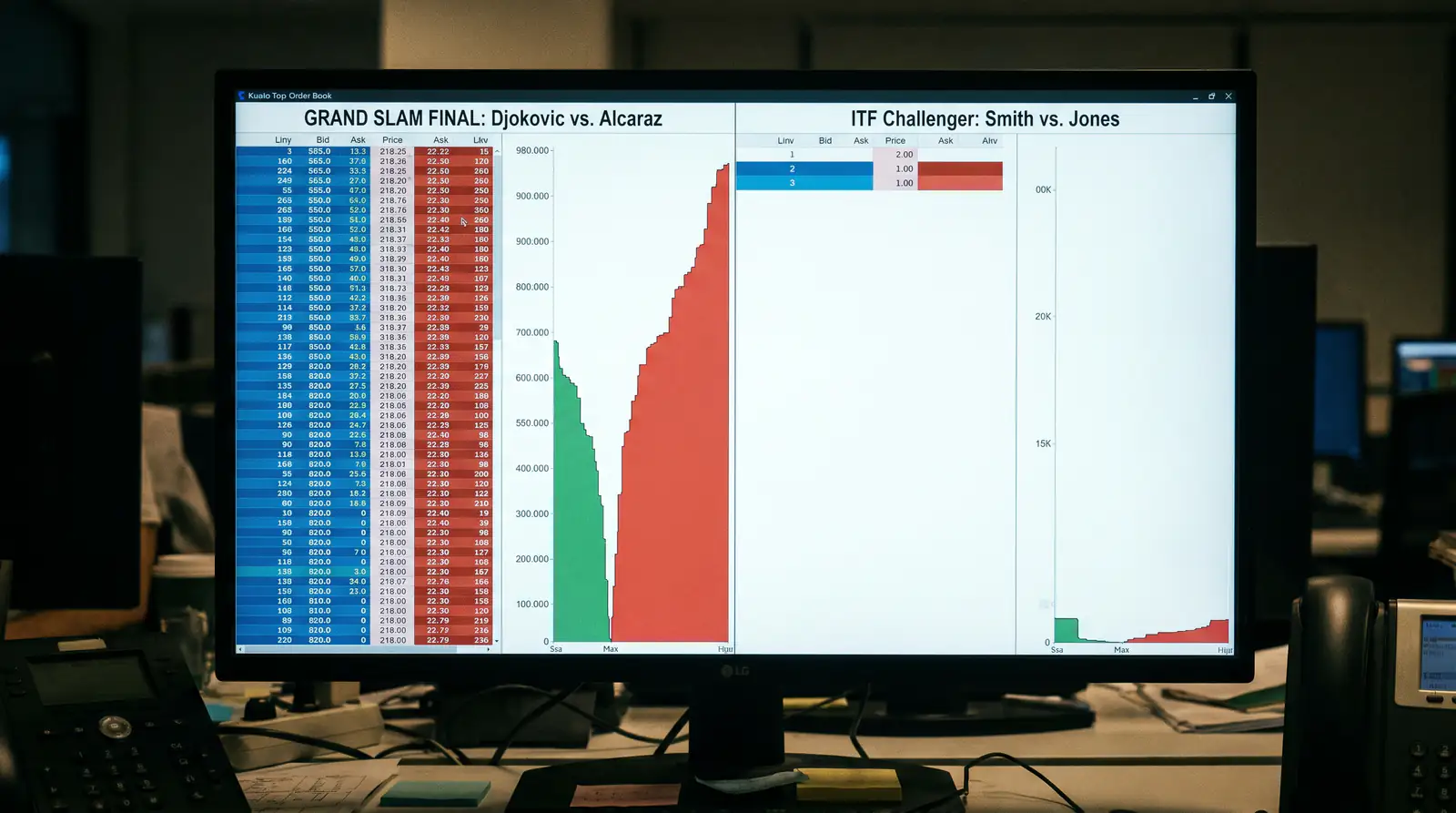
Speed is the other limitation during live trading. Exchange odds update with a slight delay relative to the action on court, and during rapid point sequences, the odds you see may not be the odds you get. Bookmakers also suspend and reopen markets between points, but exchanges handle this through the matching queue: if your bet is not matched before the odds move, it sits in the queue until the market catches up or you cancel it. In fast-moving tennis matches — particularly on grass, where points are shorter — this delay can be frustrating.
The tax treatment in the UK is favourable for exchange bettors: betting duty is paid by the operator, not the customer, so your winnings are tax-free whether they come from a bookmaker or an exchange. This is sometimes confused with spread betting, which falls under a different regulatory framework. For standard back-and-lay exchange betting on tennis, the tax position is identical to placing a bet with any UKGC-licensed bookmaker.
Articles
Created by the "bettennisonline.com" editorial team.
