
Tennis Spread Betting: How It Differs From Fixed-Odds Wagering
 Available in US
html
The first spread bet I ever placed on tennis cost me more than three months of fixed-odds losses combined. I bought total games at 23.5 in what I expected to be a tight three-setter, and the match turned into a straight-sets demolition that finished 6-1, 6-2. The result itself was not the problem – upsets happen. The problem was that every game below 23.5 multiplied my loss. In fixed-odds betting, you lose your stake. In spread betting, your loss has no predetermined ceiling unless you set one yourself. That distinction changes everything about how you approach tennis markets.
Spread betting occupies a different regulatory space, carries different risk mechanics, and rewards a different kind of analytical skill than traditional fixed-odds wagering. Tennis is roughly 8% of the UK sports-betting market by turnover, which makes it a niche within a niche for spread bettors. But the sport’s structure – binary outcomes, set-by-set scoring, quantifiable metrics like aces and double faults – creates natural spread markets that attract a dedicated following. This guide explains the mechanics, compares the two formats directly, and maps the risk profile that spread betting demands.
Contents
How Spread Betting Works in Tennis
I remember explaining spread betting to a friend who had bet on football for years, and his first reaction was “so it is like the stock market?” That analogy is closer than most people realise. In tennis spread betting, the provider quotes a spread – a range – for a particular market, and you decide whether the actual outcome will be higher (buy) or lower (sell) than that range. Your profit or loss is determined by how far the actual outcome lands from your entry point, multiplied by your stake per unit.
Take total games in a match. A spread provider might quote 22-23 for a best-of-three contest between two baseline players on clay. If you buy at 23 for GBP 5 per game and the match finishes 7-6, 4-6, 7-5 – that is 35 total games. Your profit is (35 – 23) x 5 = GBP 60. But if the match finishes 6-2, 6-1 – just 15 games – your loss is (23 – 15) x 5 = GBP 40. The asymmetry depends entirely on the market and the scenario.
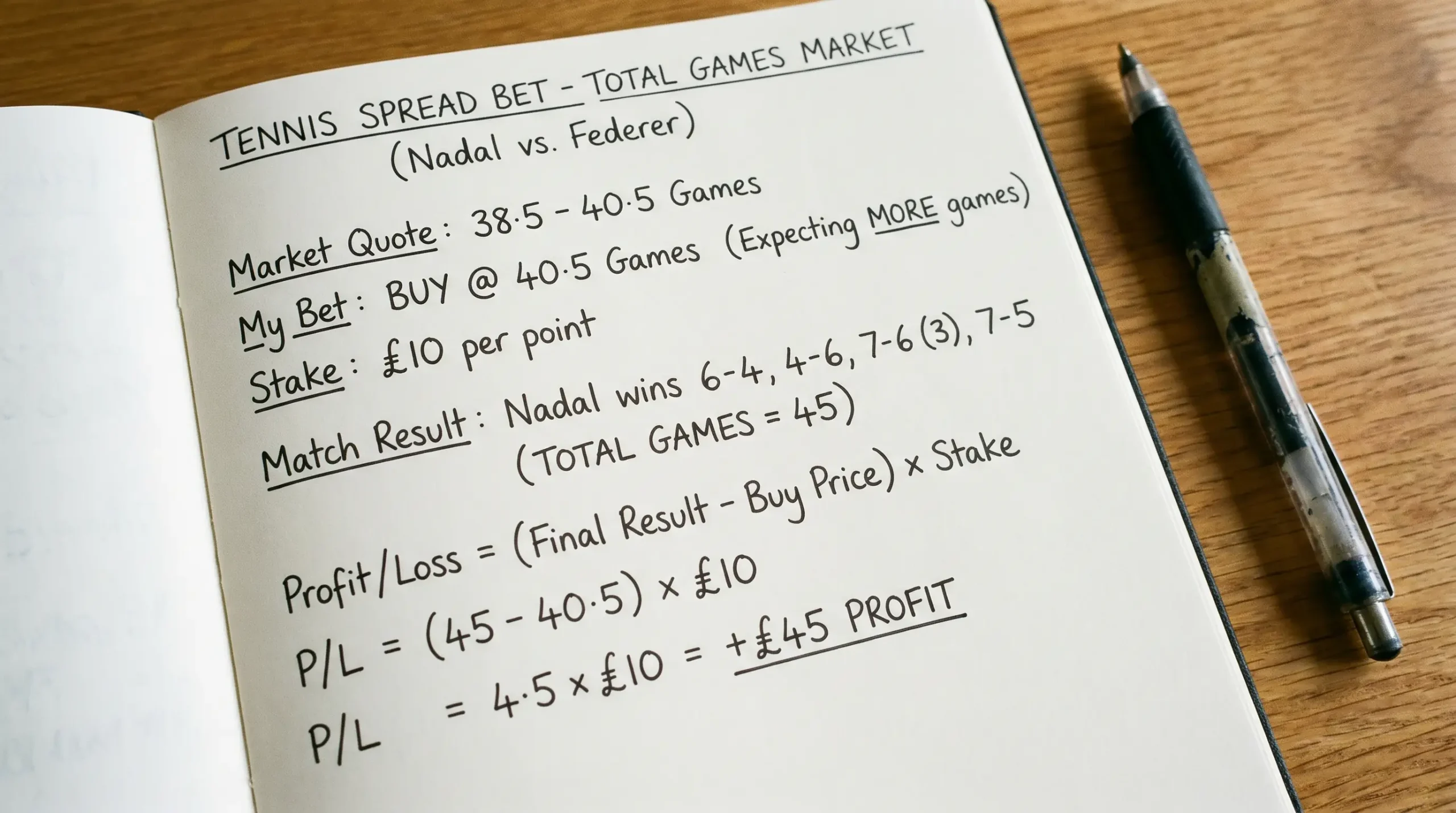
Tennis offers several natural spread markets. Total games is the most popular – it is intuitive and directly tied to match competitiveness. Player performance spreads cover metrics like aces, double faults, and total points won. Some providers offer supremacy spreads: the margin of victory expressed in games, where buying means you expect the favourite to win by more than the quoted spread. Each market has its own volatility profile. Ace spreads on grass courts can swing wildly because a single tie-break can add five or six aces to one player’s total. Game spreads in best-of-five Grand Slam matches carry more range than best-of-three encounters, which means both bigger potential profits and bigger potential losses.

The connection to exchange-style betting is worth noting. Both spread betting and exchange betting offer more granular control over your position than traditional fixed-odds markets. The key difference is that exchange betting still involves fixed payouts – you know your maximum loss at the point of placing the bet. Spread betting does not, unless you attach a stop-loss order.
Spread Betting vs Fixed Odds: Risk, Reward and Use Cases
When I switched from exclusively fixed-odds to incorporating spread positions, I had to completely rewire how I thought about risk. In fixed odds, the question is binary: will this outcome happen or not? In spread betting, the question is dimensional: by how much? That shift changes your analytical approach, your staking discipline, and your emotional relationship with a match as it unfolds.
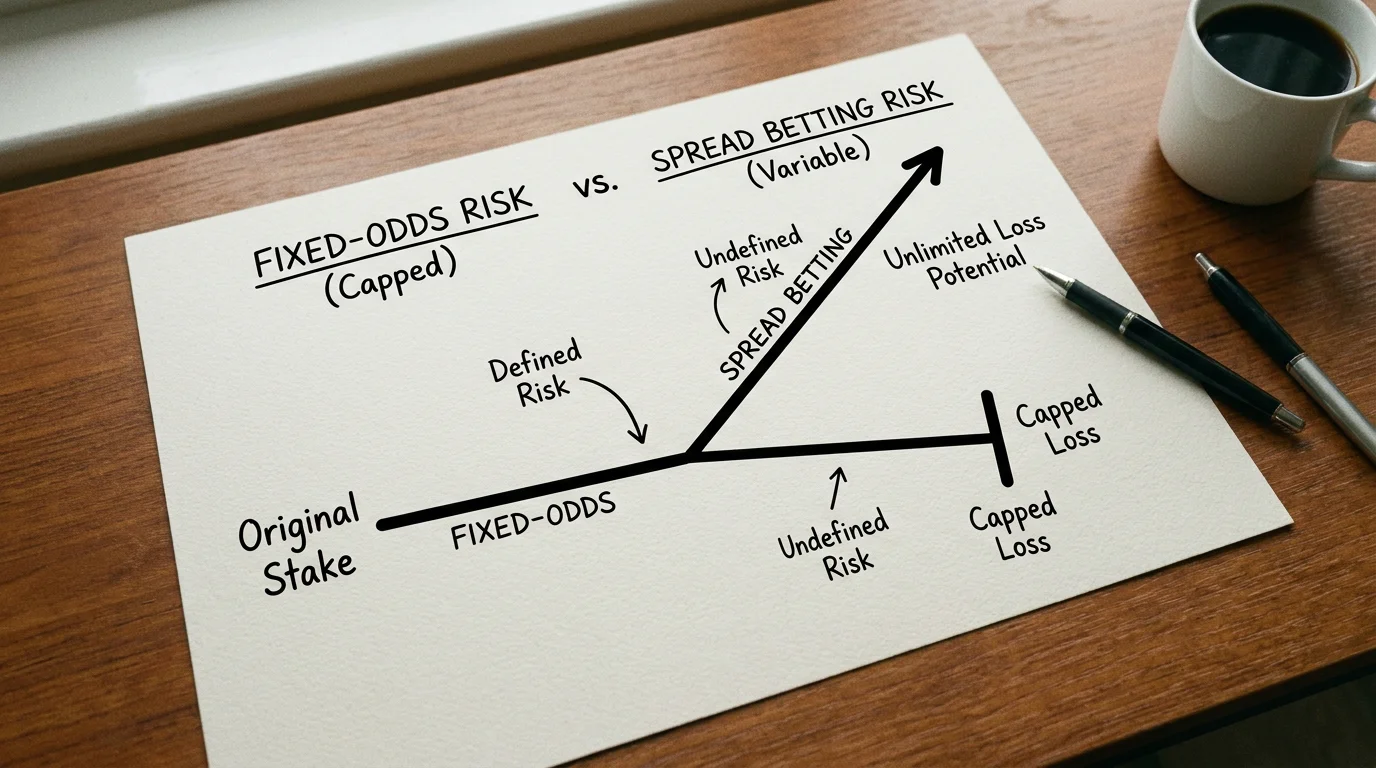
The reward profile is the obvious attraction. A fixed-odds bet on over 22.5 games pays the same whether the match delivers 23 games or 45. A spread buy at 23 pays more the further above 23 the total lands. If your analysis is not just directionally correct but precisely calibrated, spread betting rewards that precision in a way fixed odds cannot. I find this particularly valuable in tennis because the sport generates highly specific data – serve percentages, break-point conversion rates, tie-break frequencies – that supports calibrated estimates rather than simple yes/no predictions.
The risk profile is the less glamorous counterpart. Fixed odds cap your downside at your stake. Spread betting does not. A five-set match that you expected to be tight but that becomes a straight-sets rout can generate losses several times your stake-per-point. I once sold total aces for a player I believed was struggling with his serve, only to watch him fire 27 aces in a four-set win. The loss on that single position exceeded the profit from my previous eight winning spread bets. That kind of variance is baked into the product.
The tax treatment differs meaningfully in the UK too. Fixed-odds betting profits are tax-free for the bettor – the operator pays the relevant duty. Spread betting profits are also tax-free because they are classified as gambling under UK law, regulated by the FCA rather than the UKGC. However, this FCA classification means spread betting providers must comply with financial conduct rules, including risk warnings and client money protections, that fixed-odds bookmakers are not subject to. For the bettor, this means more paperwork to open an account but stronger regulatory protections on the funds you deposit.
My general rule: use fixed odds for directional views where you believe one player will win but cannot confidently estimate the margin. Use spread betting when your analysis generates a specific numerical estimate – total games, total aces, player break points – and you believe the provider’s quote is meaningfully off.
The Magnified Risk: Why Spread Betting Demands Discipline
A statistic I return to whenever I feel tempted to increase my spread stakes: gambling-related harm costs the UK economy between GBP 260 million and GBP 1.2 billion annually. That range is wide, but even the lower bound reflects the serious financial consequences that disproportionately affect bettors in leveraged products. Spread betting is not inherently more dangerous than fixed odds – I want to be clear about that – but the open-ended loss structure means that poor discipline punishes you faster and harder.
The first discipline is stop-losses. Every spread position I open has a stop-loss attached. Without one, you are exposed to the theoretical maximum range of the market. In a total-games spread, the theoretical maximum in a best-of-five match is around 65 games (five sets all reaching tie-breaks). If you have bought at 38 for GBP 10 per game, your maximum loss without a stop-loss would be (38 – 18) x 10 = GBP 200 on the downside if the match finishes in straight sets at 6-0, 6-0, 6-0. More realistically, a stop-loss at 28 caps your loss at GBP 100 and lets you sleep at night.

The second discipline is position sizing. I never risk more than 1% of my total bankroll on a single spread position, measured at the stop-loss level rather than at the entry point. This means my stake per point is calculated backwards from the maximum loss I am willing to accept, not forwards from the profit I hope to make. A spread bettor who stakes based on potential profit rather than potential loss is one bad match away from a devastating drawdown.

The third discipline is market selection. Not every tennis spread market deserves your attention. Ace markets are high-variance by nature. Double-fault markets can be influenced by a single bad service game under pressure. I concentrate on total-games markets because the variance is more predictable, the data inputs are more reliable, and the pricing tends to be more efficient – which sounds counterintuitive, but efficient pricing means fewer blow-ups even if the edge per bet is narrower.
Spread betting suits a specific type of bettor: someone who enjoys quantitative analysis, respects risk management as a non-negotiable part of the process, and has the emotional discipline to close a position at a loss without chasing the next market to recover. If that does not describe you, fixed-odds tennis betting offers every analytical challenge without the leveraged risk. There is no shame in choosing the format that matches your temperament.
Articles
Prepared by the bettennisonline.com editorial staff.
