
Tennis Head-to-Head Betting: Using Player Records to Inform Your Wager
 Available in US
html
I once backed a player who held a 7-2 head-to-head advantage against his opponent. Looked bulletproof. What I had not noticed was that six of those seven wins came on hard courts – and they were about to play on clay. He lost in straight sets. That single bet taught me more about head-to-head analysis than any model I had built: the record matters, but the record without context is noise dressed up as signal.
Head-to-head records are among the most overrated and most underrated inputs in tennis betting, depending entirely on how you use them. Overrated when taken at face value – a raw win-loss number tells you almost nothing actionable. Underrated when filtered by surface, recency, and match conditions, because those filtered records can reveal stylistic dynamics that rankings and serve data miss entirely. This guide breaks down how I read H2H records, why surface filtering is non-negotiable, and where the data misleads even experienced analysts.
Contents
How to Read Head-to-Head Records Beyond the Win-Loss Line
ATP’s move to full electronic line-calling – Hawk-Eye Live across all tournaments from 2026 onward – has eliminated one variable from match analysis, but it has not changed the fundamental challenge of interpreting head-to-head data. A record like 5-3 in favour of Player A tells you the outcome of eight matches. It tells you nothing about the margins, the surfaces, the stages of career those matches represent, or the conditions under which they were played.
The first thing I do with any H2H record is decompose it by set scores. A player who has won five of eight meetings but has won three of those in deciding sets – 7-6 in the third, 6-4 in the fifth – holds a far less dominant position than a player who has won five of eight in straight sets. Close set scores suggest the matchup is competitive regardless of the win-loss headline, and competitive matchups are where the market often misprice the underdog.
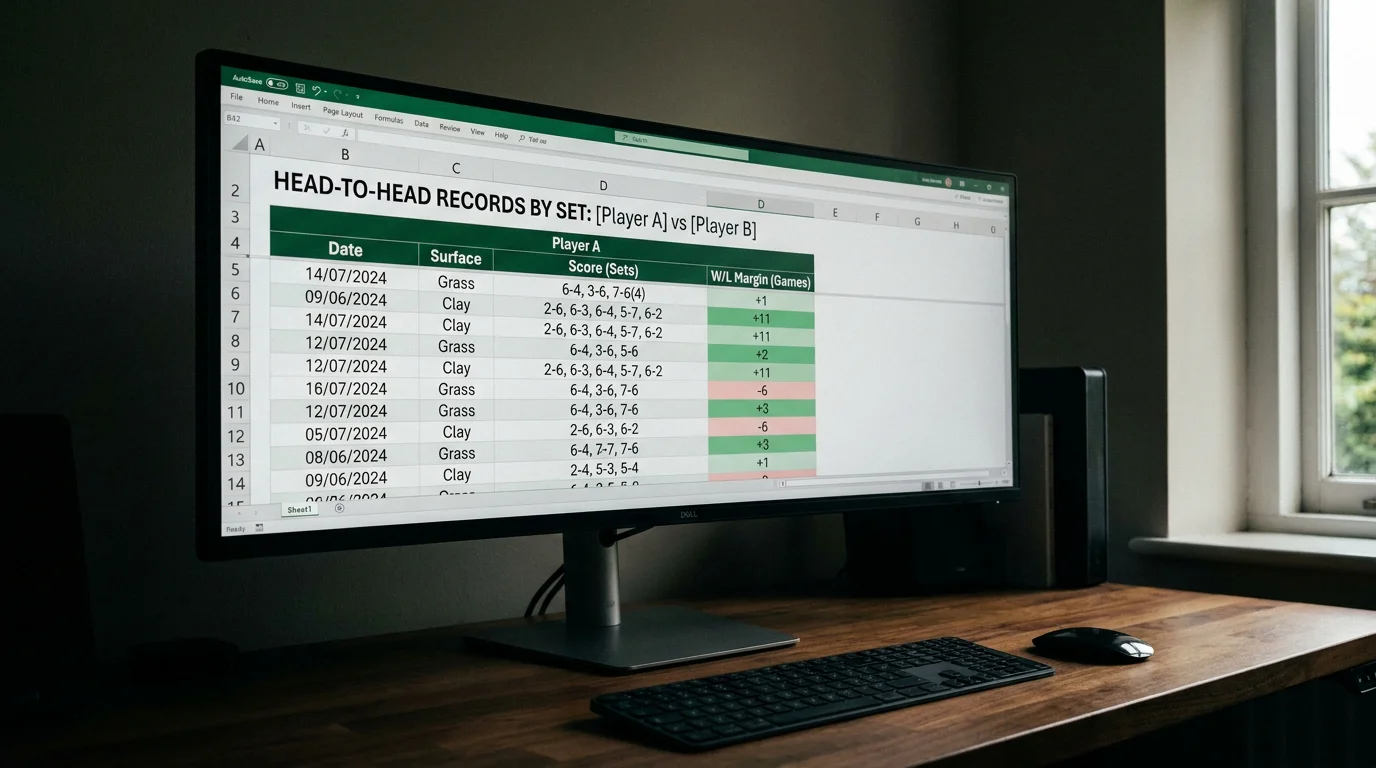
Recency weighting is the second filter. Tennis players evolve rapidly. A head-to-head record that spans eight years includes matches between fundamentally different versions of both players. I discount meetings older than three years almost entirely unless the players’ games have remained unusually stable. A 22-year-old who lost to a veteran three times as a teenager is not the same player at 25, and the old losses tell you nothing about the current dynamic.
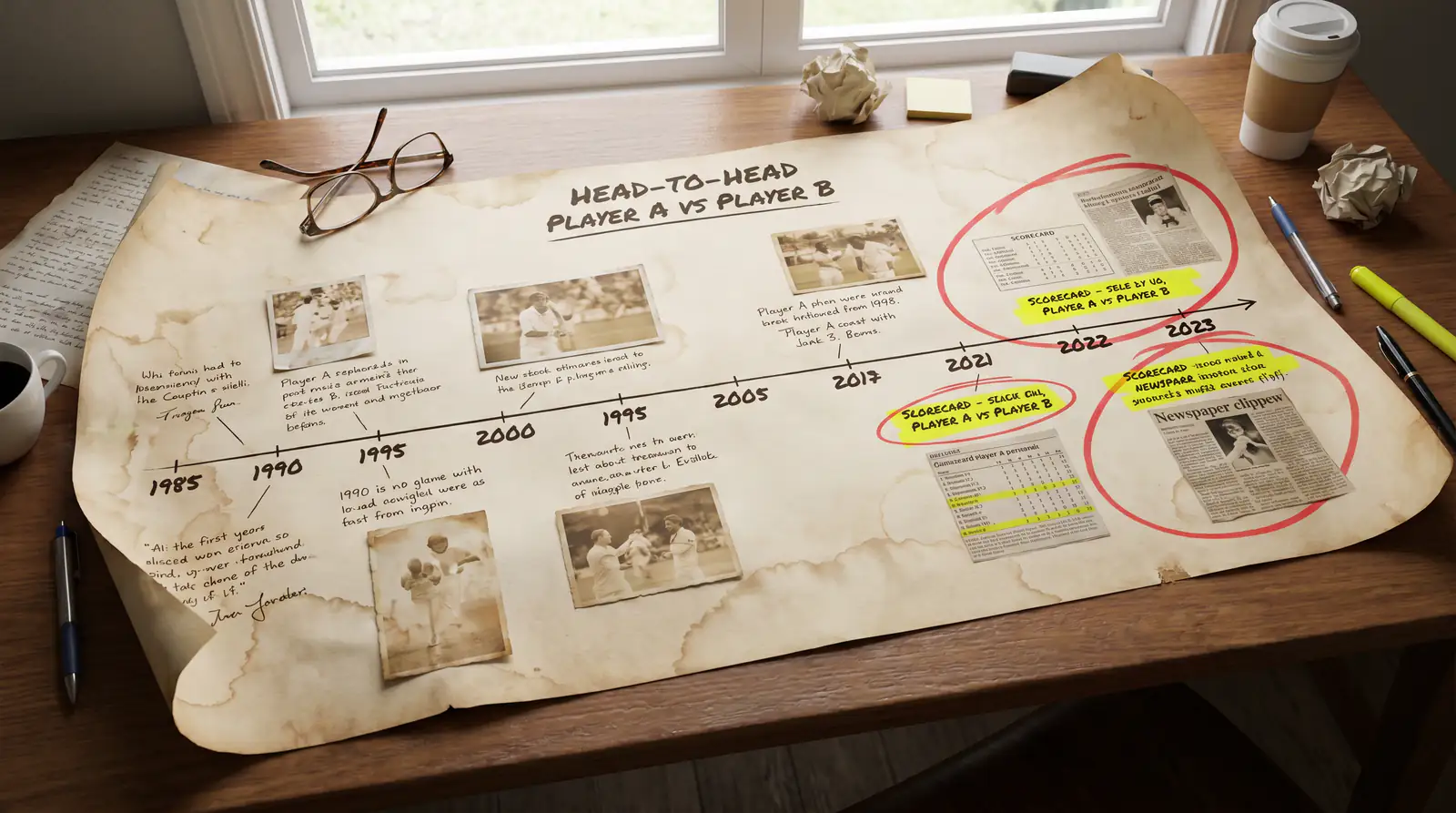
The third filter is tournament stage. A first-round meeting at an ATP 250 carries different psychological weight than a semi-final at a Masters 1000. Some players perform significantly differently in high-pressure stages, and a head-to-head record that is entirely built from early-round matches may not predict behaviour when both players have deep runs at stake. I track this dimension separately in my database and weight late-round meetings more heavily when assessing upcoming contests at equivalent stages.
Finally, I look at service-game data within the H2H. If Player A has won five of eight matches but has consistently been broken more often than Player B in those encounters – winning through superior return play rather than dominant serving – the dynamic shifts on faster surfaces where service holds become more automatic. Two players might have identical H2H records on aggregate but completely different competitive profiles underneath.
Surface-Filtered H2H: Why Context Matters More Than Totals
Last year I ran an analysis across 150 H2H pairs with ten or more meetings. The correlation between the overall H2H record and the outcome of the next match was modest – barely above what ranking alone would predict. When I filtered by surface, the correlation jumped significantly. A player who leads 4-1 on clay against a specific opponent has a far more predictive record than one who leads 7-3 across all surfaces.
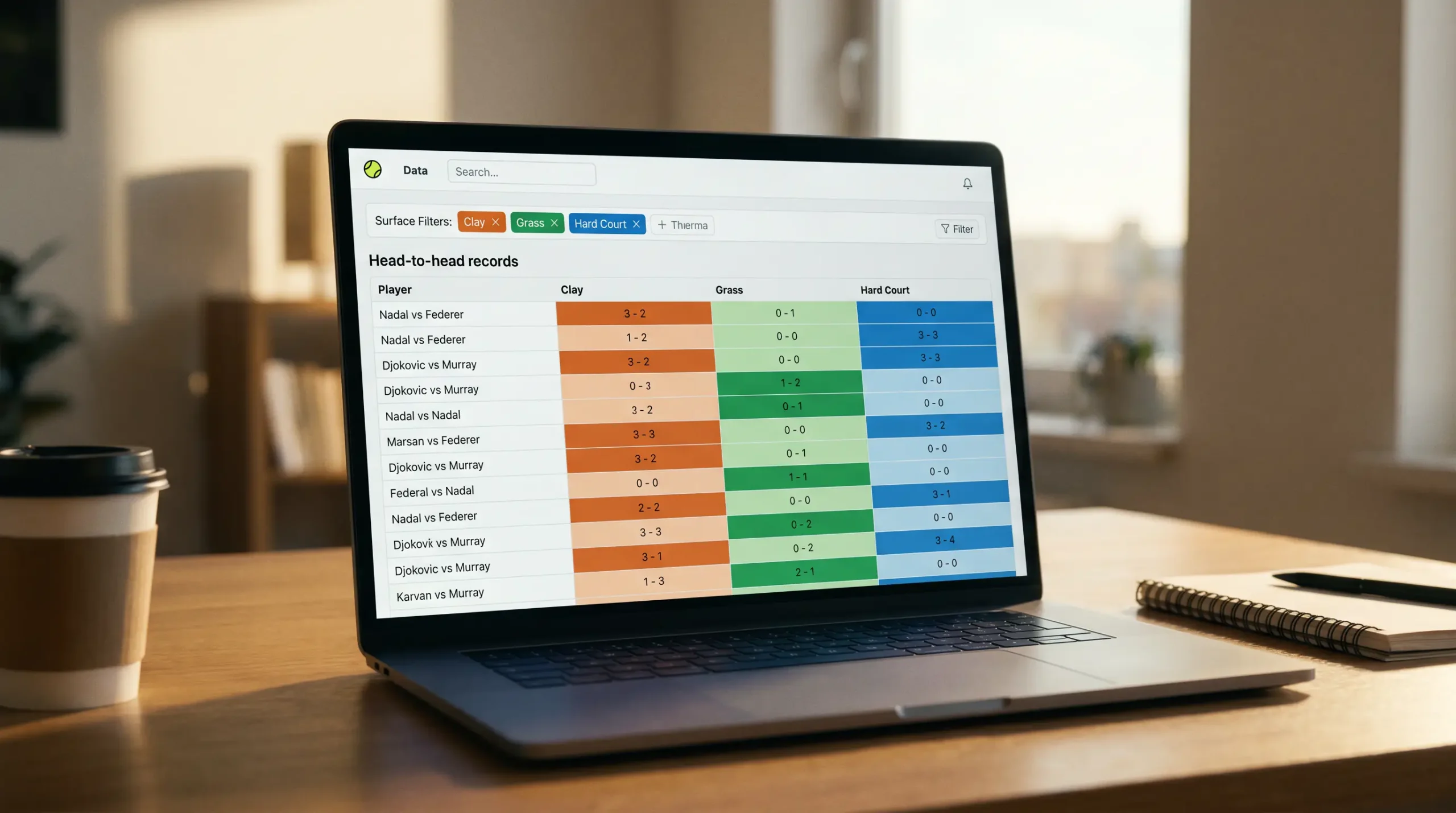
The reason traces back to surface-specific playing styles. First-serve efficiency varies meaningfully by surface – 62.4% on clay, 64.2% on grass, and 67.5% on hard courts according to random-forest analytics research. Those differences do not sound dramatic in isolation, but they compound across the patterns of a specific matchup. A player whose game thrives on extending rallies and exploiting movement will dominate a particular opponent on clay while struggling against the same player on grass where shorter rallies negate that advantage.
I maintain surface-specific H2H columns in my tracking spreadsheet, and I refuse to include a meeting on one surface in my assessment of a match on another unless both players are genuinely surface-neutral – which very few are. The practical strategic application is straightforward: before any bet where H2H is a factor, filter the record by the surface of the upcoming match. If the filtered sample is too small – fewer than three meetings on that surface – discount the H2H entirely and rely on individual surface performance data instead.
The surface transition periods I mentioned are particularly treacherous for H2H analysis. A player who has beaten an opponent three consecutive times on indoor hard courts during the winter season may face a completely different challenge when they meet on outdoor clay in May. The H2H record says dominance; the surface context says uncertainty. I have learned to trust the surface context.
When Head-to-Head Data Misleads
There is a cognitive bias in tennis betting that I call “H2H anchoring” – the tendency to overweight a head-to-head record because it feels like direct evidence. Your brain treats “Player A has beaten Player B four times” as more meaningful than “Player A’s surface Elo is 80 points higher than Player B’s,” even though the Elo gap is far more predictive. Direct encounters feel concrete. Statistical models feel abstract. The concrete evidence wins in your gut, which is precisely why the gut is often wrong.

Small samples are the primary source of misleading H2H data. Two or three meetings are not a meaningful sample in any statistical sense. A player who has won two of two encounters has a 100% H2H win rate, but the confidence interval around that estimate is enormous. With only two data points, you cannot distinguish between genuine dominance and luck. I require a minimum of five surface-specific meetings before I allow the H2H record to influence my probability estimate by more than 2%.
Career-phase mismatches create another distortion. Consider two players who met six times between 2018 and 2021 when Player A was in peak form and Player B was developing. Player A won all six. In 2026, Player B has improved dramatically while Player A has declined. The 6-0 record is not just stale – it is actively misleading, because it reflects a competitive dynamic that no longer exists. I have seen the market price these matchups as though the historical dominance persists, and the correction when the match plays out differently creates some of the largest single-match edges I encounter.
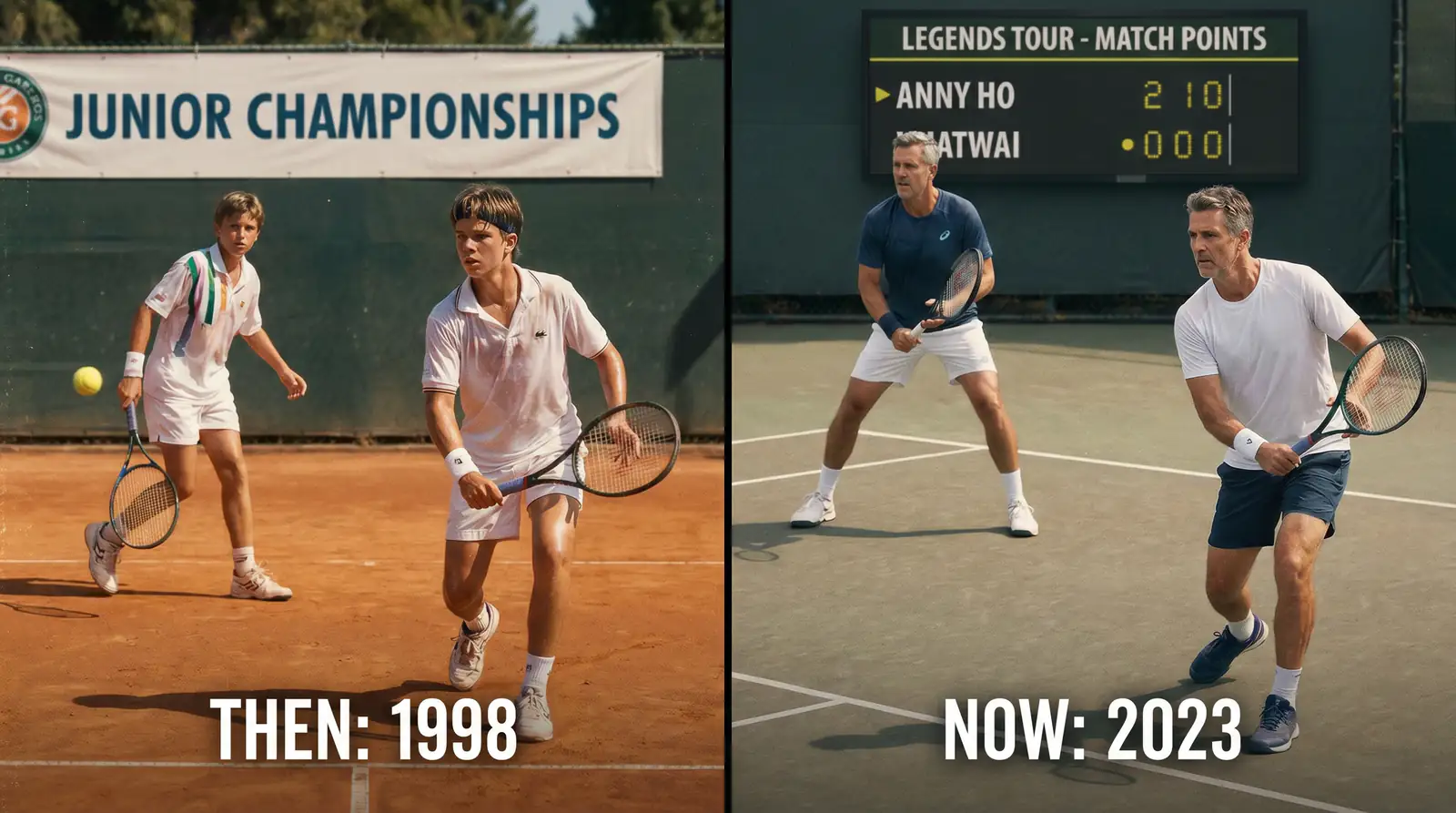
Injury and comeback contexts also distort H2H interpretation. If two of a player’s three H2H losses came while they were managing a chronic injury, those losses do not represent their true competitive level against that opponent. Conversely, a victory over an opponent who was clearly impaired tells you nothing about the matchup at full strength. I annotate every H2H meeting in my database with context flags – injury, fatigue, surface, stage – and the annotated record tells a story that the raw numbers never could.
The best approach to H2H data is to treat it as one input among several, weighted according to sample size, recency, and surface relevance. Used that way, it genuinely improves your probability estimates. Treated as headline evidence – “he always beats him” – it will cost you money as surely as ignoring it entirely.
Articles
Created by the "bettennisonline.com" editorial team.
