
Tennis Bankroll Management: Sizing Stakes and Protecting Your Betting Fund
 Available in US
html
I blew my first tennis bankroll in eleven days. Not through bad selections – my win rate that fortnight was actually above 50% – but through atrocious staking. I would bet GBP 50 on a match I was certain about and GBP 10 on one I was less sure of, with no system, no rationale, and no concept of what a drawdown could do to a fund managed on gut feeling. The selections were fine. The money management was catastrophic. Eleven years later, I consider bankroll management the single most important skill in my betting – more important than match analysis, more important than finding value, more important than understanding markets.
Your bankroll is not spending money. It is capital. Treat it the way a trader treats a trading account: with rules, with discipline, and with the understanding that protecting the fund matters more than maximising any individual bet. This guide covers the three staking methods I have used, the tennis-specific risks that make bankroll management harder than in most sports, and the tracking habits that keep the entire system honest.
Contents
Flat Stakes, Percentage and Kelly: Choosing a Staking Method
David Lampitt, CEO of Tennis Data Innovations, once described the sports-data industry as pursuing “a landmark opportunity to realise growth ambitions and take the fan experience to the next level.” That ambition has given bettors access to data infrastructure that was unimaginable a decade ago – but all the data in the world is useless if your staking method bleeds your bankroll dry before your edge has time to compound. The method you choose determines the shape of your journey far more than the selections themselves.
Flat staking is the simplest approach: you bet the same amount on every selection regardless of confidence or odds. If your bankroll is GBP 1,000 and your flat stake is GBP 20, every bet is GBP 20 whether you are backing a 1.40 favourite or a 3.50 outsider. The advantage is psychological simplicity – no decisions to make, no temptation to oversize on “certain” winners. The disadvantage is inefficiency. Flat staking does not account for edge size. A bet where you estimate a 10% edge receives the same stake as one with a 2% edge, which leaves money on the table.
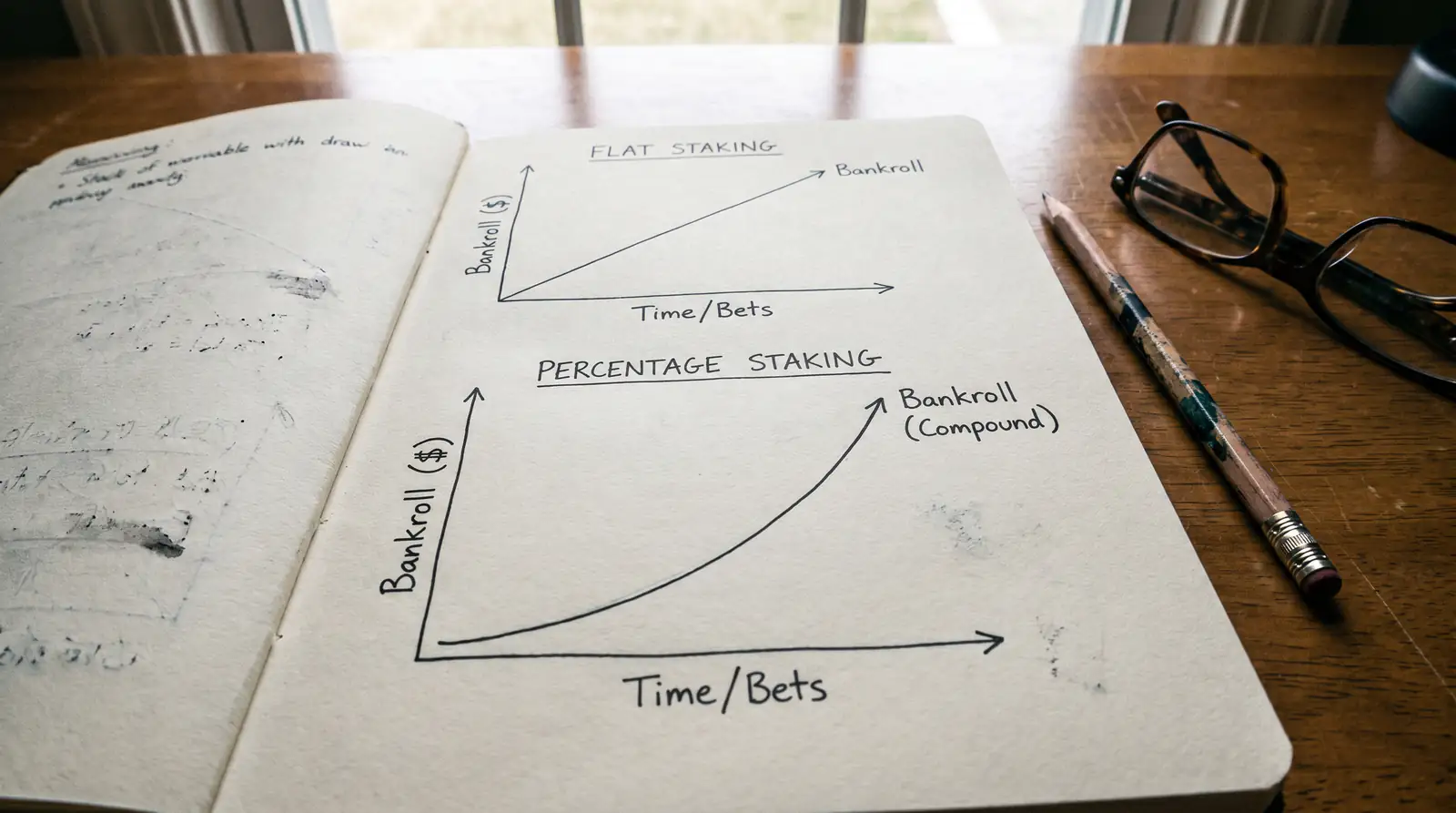
Percentage staking adjusts automatically. Instead of a fixed GBP amount, you stake a fixed percentage of your current bankroll – typically 1-3%. If your bankroll grows to GBP 1,200, your 2% stake becomes GBP 24. If it shrinks to GBP 800, the stake drops to GBP 16. This method has a built-in survival mechanism: as you lose, your stakes shrink, making it mathematically difficult to bust your bankroll entirely. I used percentage staking for my first four years and it served me well – it forced discipline during losing runs and compounded gains during winning streaks.
The Kelly criterion is the most mathematically rigorous approach. It calculates the optimal stake based on your estimated edge and the odds offered. The formula is: Stake = (Edge / Odds – 1) where Edge = (Your Probability x Decimal Odds) – 1. If you estimate a player has a 55% chance of winning at odds of 2.00, the Kelly stake is (0.55 x 2.00 – 1) / (2.00 – 1) = 0.10, or 10% of your bankroll. Full Kelly is aggressive – most profitable bettors use a fraction, typically quarter-Kelly (2.5% in this example) to smooth out the variance.

I now use quarter-Kelly for my primary value-based selections and flat 1% stakes for lower-conviction bets where my probability estimate is less precise. The combination gives me the efficiency of Kelly on my strongest selections while maintaining the discipline of flat staking on everything else. Gambling addiction costs the UK economy between GBP 260 million and GBP 1.2 billion annually – a range that underscores why disciplined staking is not just a strategy but a responsibility.
Tennis-Specific Bankroll Risks: Retirements, Walkovers and Variance
Every sport has bankroll risks, but tennis has a set that is genuinely unique. The first is retirements. A player can withdraw mid-match due to injury, and the rules on how your bet is settled vary by operator and market. Some void match-winner bets if a retirement occurs before a certain point. Others settle against the player who retired. Set-betting markets are typically voided if the relevant set was not completed. The inconsistency across operators means that a single retirement can produce different financial outcomes depending on where you placed the bet.
I factor retirement risk into my bankroll planning by capping my total exposure on any player I consider injury-prone at 1.5% of my bankroll across all active bets. If I have backed that player in a match-winner market and a set-betting market, the combined stake cannot exceed 1.5%. This cap prevents a single retirement from creating an outsized drawdown. Roughly 18% of UK adults plan to bet on sports in 2026, and the vast majority of them will never consider retirement risk as a bankroll factor – which is precisely why it catches people off guard.

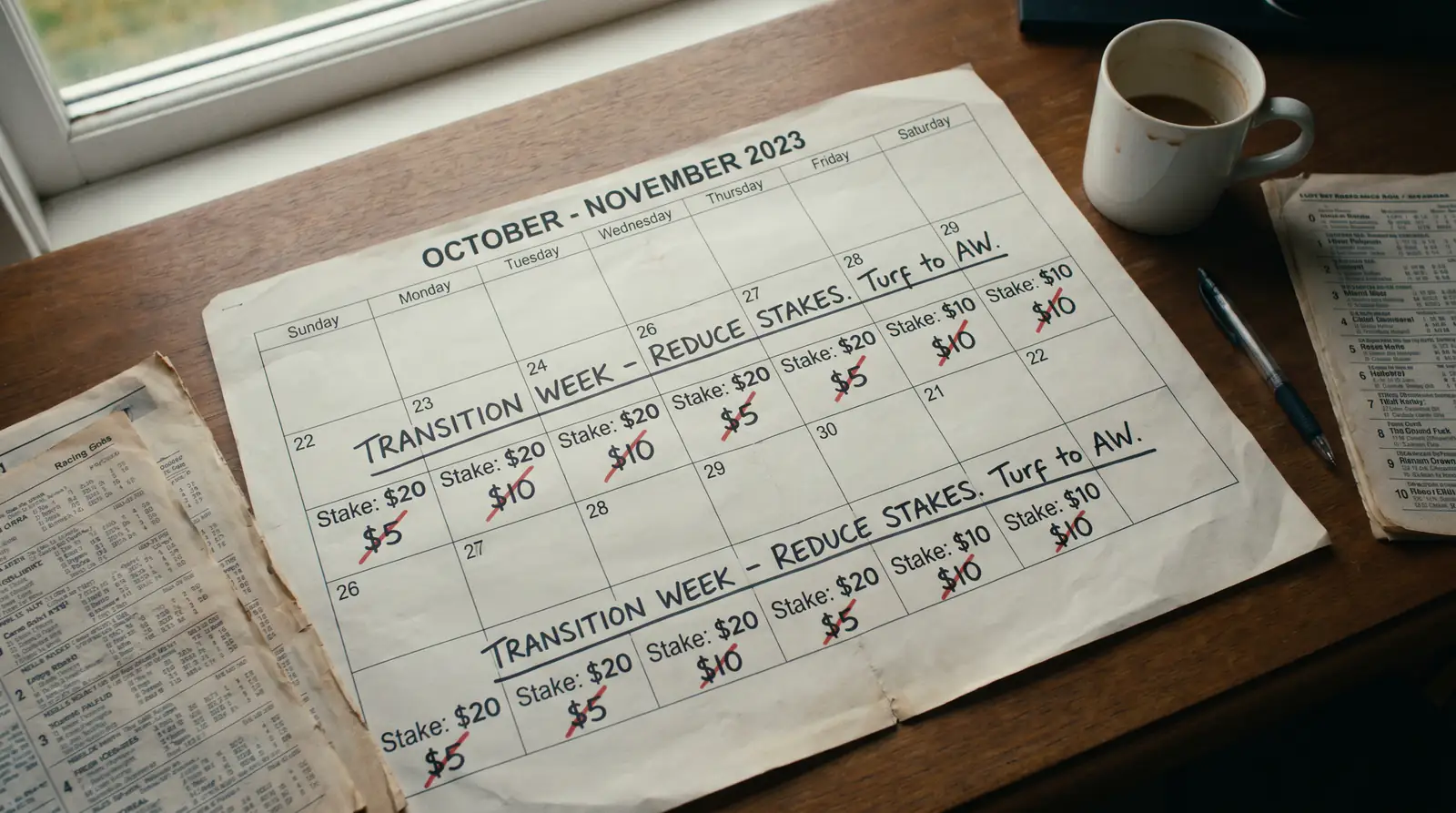
The second tennis-specific risk is surface transition variance. When the tour shifts from clay to grass, form becomes unreliable for the first week or two. Models trained on six weeks of clay-court data suddenly encounter a completely different surface, and prediction accuracy drops. During these transition weeks, I reduce my standard stake by 25% and increase my minimum EV threshold for placing a bet. The data will catch up, but protecting the bankroll through the adjustment period is essential.
The third risk is scheduling density. The ATP and WTA calendars run nearly year-round, and the temptation to bet on every day’s slate is powerful. More bets means more exposure, and if your edge is smaller than you estimate – which it often is during busy periods when you are analysing fifteen matches per day instead of five – the cumulative exposure can create meaningful drawdowns. I set a hard cap of 5% total bankroll exposure per day, regardless of how many attractive opportunities I identify. Some days that means leaving good-looking bets unplaced. That discipline has saved my bankroll more than once.
Tracking Bets and Reviewing Results Over Time
Last summer I discovered that my grass-court betting had been break-even for two years. Not losing, not winning – exactly flat. I only found this because I had tracked every bet in a spreadsheet with surface, tournament level, and estimated edge. Without that data, I would have continued allocating bankroll to a segment where I had no demonstrated advantage. The tracking revealed the problem, I adjusted my grass-court models, and the following season turned profitable.

Every bet I place goes into a database with the following fields: date, tournament, surface, players, market, odds, stake, estimated probability, estimated EV, and result. After every 200 bets, I review four metrics. First, actual return versus estimated return – the gap tells me whether my probability estimates are calibrated. Second, ROI by surface – identifies which surfaces my models handle well and which need refinement. Third, drawdown depth and recovery time – shows whether my staking method is appropriately conservative. Fourth, bet frequency versus win rate – flags periods where I am over-betting and diluting my edge.
The review process is not glamorous. It takes two or three hours every few weeks, and the findings are sometimes uncomfortable. But it is the feedback mechanism that transforms betting from gambling into a system. Without tracking, you are relying on memory, and memory is unreliable. You remember the spectacular winners and forget the quiet losers. You remember the months where everything clicked and blur the months where the drawdown felt endless.
One practical tip: track your staking discipline as a separate metric. Did you follow your staking rules on every bet, or did you deviate? If you deviate more than 10% of the time, the staking method is either wrong for your temperament or you lack the discipline to execute it. Either way, the tracking tells you – and knowing is the first step toward fixing it.
Articles
Prepared by the bettennisonline.com editorial staff.
