
Tennis Match-Fixing and Betting Integrity: What the Data Reveals
 Available in US
html
In 2019, I placed a bet on a Challenger-level match where the live odds moved so violently in the second set that I closed my position at a loss just to get out. The favourite was broken three times serving at 40-0 in that set. I cannot prove anything happened – and that is precisely the point. The line between bad form and bad intent is invisible to the bettor in real time. What we do have is data, and the data from the past several years paints a picture that every serious tennis bettor needs to understand.
Football and tennis dominated suspicious betting activity in 2026, with tennis accounting for 74 alerts out of 300 total flagged by the International Betting Integrity Association – roughly 25% of all global integrity alerts across every sport monitored. That figure does not mean tennis is uniquely corrupt. It means tennis has specific structural features that make certain matches vulnerable, and understanding those features is essential if you want to bet intelligently on the sport.
Contents
The IBIA Alert Landscape: 300 Alerts in 2026
I track IBIA reports the way some bettors track injury bulletins – they are that important to my market analysis. The organisation recorded 300 suspicious betting alerts across all sports in 2026, a 29% increase from the 232 alerts logged in 2026. Before you read that as an alarming escalation, context matters. The IBIA’s Global Monitoring and Alerting Platform expanded its coverage significantly during this period. More matches monitored means more alerts generated, even if the underlying rate of suspicious activity stays flat.
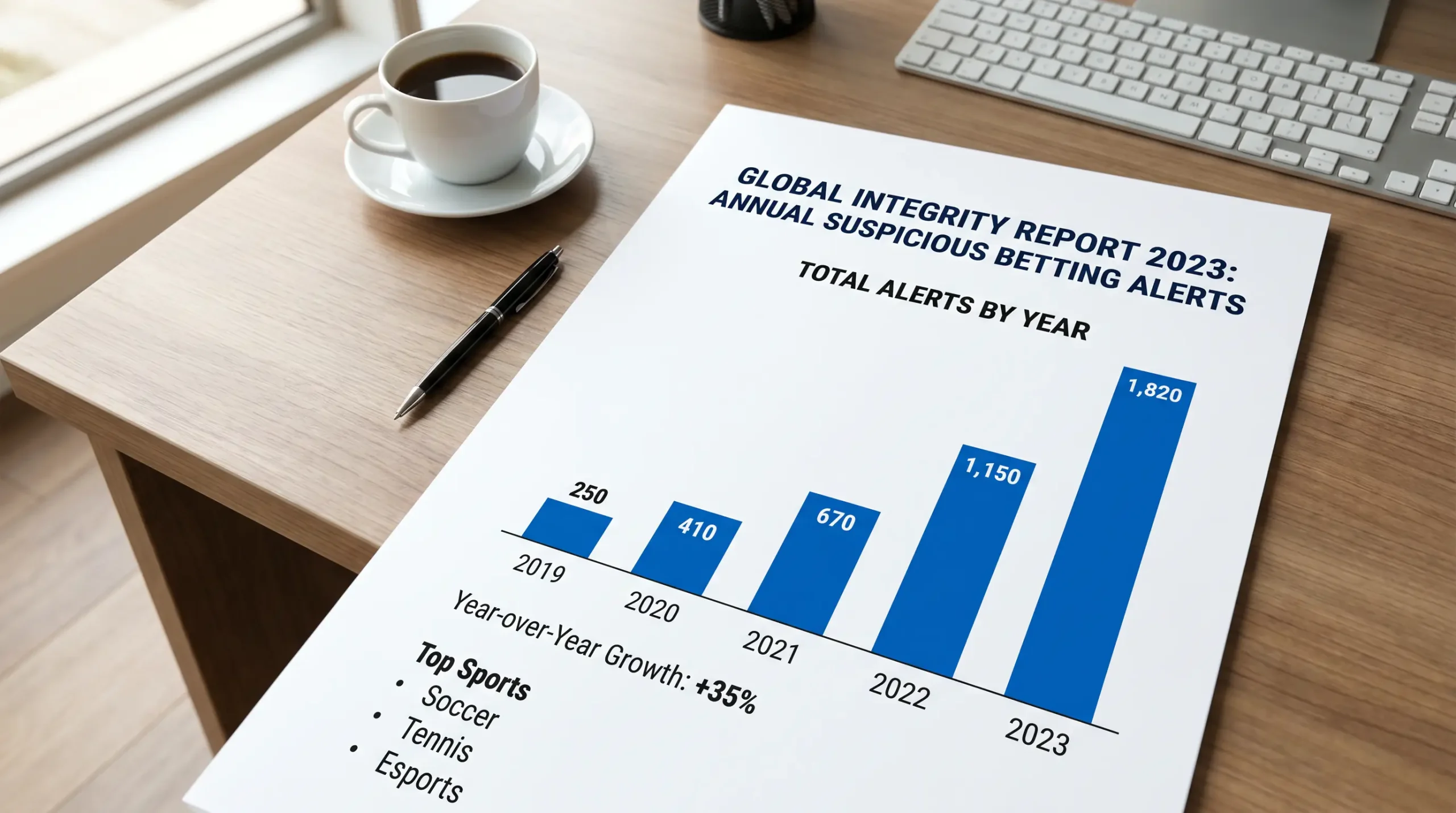
Football led with 110 alerts – 37% of the total. Tennis followed with 74, making up 25% of all alerts. These two sports have held the top positions for years, and the reasons are structural rather than cultural. Both sports generate enormous betting volumes, operate across dozens of countries with varying oversight, and feature lower-tier competitions where prize money alone cannot sustain a professional career.
The quarterly breakdown reveals something I find more telling than the annual totals. In Q3 2026, tennis briefly overtook football in suspicious alert volume – roughly 30% of quarterly alerts versus football’s 25%. That spike coincided with the dense Challenger and ITF calendar during the North American hard-court swing, when dozens of low-profile events run simultaneously with minimal broadcast coverage. The alerts dropped back in Q4, but the seasonal pattern reinforces what the data has shown for years: integrity risk in tennis clusters around specific times and tiers of competition.

The IBIA now monitors more than 1.5 million matches annually across 80-plus sports, covering an estimated GBP 300 billion in global betting turnover. The scale of that monitoring infrastructure means the alert data is increasingly reliable as a proxy for where problems concentrate – even if it inevitably misses activity in unregulated markets.
Lower-Tier Tennis: Where Most Integrity Risks Concentrate
I stopped betting on ITF M15 events three years ago. Not because the tennis is bad – some genuinely talented young players compete at that level – but because the pricing is too unreliable for me to trust my models. The ITIA received 23 match alerts in Q4 2026 and 26 in Q3 2026 through confidential memoranda of understanding with betting industry partners. The overwhelming majority of those alerts originated from the lowest rungs of the professional ladder.
The IBIA’s own Q3 2026 integrity update stated it plainly: the majority of tennis cases originated from lower-tier competitions, reflecting long-standing vulnerabilities in the sport. Those vulnerabilities are economic at their core. A player ranked 250th in the world might earn GBP 30,000 in annual prize money – before coaching costs, travel, equipment, and tournament entry fees. A player ranked 500th earns far less. When a single match payment from a corrupt approach exceeds what a player earns in six months of legitimate competition, the incentive structure is stark.

This does not mean every lower-tier match is compromised. The actual number of confirmed corrupt matches is far smaller than the alert total suggests. In 2026, IBIA data confirmed corruption in 54 matches across all sports, with sanctions imposed on 24 individuals – athletes, team members, and officials – across five sports. Tennis accounted for a portion of those sanctions, but the specific breakdown by sport is not always disclosed in public reports.
For bettors, the practical takeaway is not to avoid lower-tier tennis entirely but to approach it differently. I apply a wider confidence interval to any probability estimate below Challenger level, and I require a higher EV threshold – typically 8% rather than my usual 5% – before placing a bet. If the odds move sharply in a direction my model does not support, I stay out entirely rather than chase what might appear to be value.
What the Integrity Data Means for Bettors
There is a temptation to treat integrity data as someone else’s problem – a matter for regulators and governing bodies, not for the person placing a GBP 20 bet on a Tuesday afternoon. That view misses the direct impact on your bottom line. If a match you have bet on is manipulated, you lose not because your analysis was wrong but because the event was not a genuine contest. Your model assumed two players trying to win. Remove that assumption and the model is worthless.
I use integrity data as a filter layer in my betting process. Before placing any bet below ATP 250 or WTA 250 level, I check three things. First, does this match involve a player with a history of suspicious odds movements? Services that track historical odds patterns make this possible without requiring insider information. Second, is the match being played in a jurisdiction with robust on-site integrity officers? The ATP and WTA mandate integrity presence at their events, but coverage at ITF Futures events is thinner. Third, how liquid is the betting market? Matches with very thin liquidity are easier to manipulate because smaller amounts of money can shift the odds significantly.

The broader trend is encouraging, despite the headline numbers. The regulatory infrastructure around tennis betting has strengthened considerably. The IBIA’s monitoring capabilities have expanded, the ITIA has increased its investigative capacity, and the introduction of UK gambling legislation including the statutory levy is directing more funding toward integrity work. The 300 alerts in 2026 reflect better detection as much as they reflect underlying corruption – a distinction that matters enormously for how you interpret the data.

My approach has evolved from avoiding suspicious markets entirely to using integrity data as another input in my overall assessment. A match at Challenger level with normal liquidity, no adverse odds movement, and two players with clean records is not meaningfully riskier than a Masters 1000 contest. The risk is concentrated, not universal, and the bettor who understands where it concentrates can navigate the lower tiers profitably while sidestepping the matches that should raise flags.
Articles
Published by the bettennisonline.com team.
