
Tennis Over/Under Games: How Totals Markets Work and When to Use Them
 Available in US
html
Totals markets strip away the question of who wins and replace it with something I find more analytically interesting: how long will this match last? Over/under games betting gives you a line — say 22.5 total games — and asks whether the match will produce more or fewer games than that number. It is a market that rewards understanding of playing styles, surface conditions, and physical matchups rather than just ranking differentials. And it is the market where I have built the most consistent edge over the past decade.
The reason is straightforward. Most recreational bettors focus on picking winners. That concentrates the sharp money and public money on the same side of the match-winner market, which makes those odds efficient. Totals markets attract less attention, which means the lines are softer and mispricings persist longer.
Contents
How Bookmakers Set Total-Game Lines in Tennis
I spent a week in 2020 reverse-engineering the totals lines for every ATP 500 match that season, trying to understand the inputs. The answer turned out to be less mysterious than I expected: surface speed, serve statistics, and recent head-to-head margins do most of the work.
The bookmaker starts with a model-generated line based on each player’s serve-hold percentage and break-conversion rate on the relevant surface. Random-forest models have identified serve strength as the top match-outcome predictor with accuracy above 80%, and those same serve metrics feed directly into totals pricing. A match between two dominant servers on a fast surface will have a higher total line — perhaps 24.5 or 25.5 — because fewer breaks of serve means more games are needed to decide sets. Conversely, a match between two aggressive returners on slow clay will have a lower line, perhaps 20.5 or 21.5, because breaks come more easily and sets resolve more quickly.

Once the model generates the opening line, the bookmaker adjusts for public perception and early money flow. If a popular player is involved, recreational bettors tend to push the line slightly because they imagine a longer, more dramatic match. That bias creates a small but repeatable opportunity to take the under in matches involving household names against lower-ranked opponents who are likely to be outclassed quickly.
The half-game increment eliminates draws. A match cannot produce exactly 22.5 games, so every totals bet resolves as a win or a loss. Some operators offer quarter-game lines (22.25 or 22.75) that split your stake across two lines, but in the UK market, half-game lines are standard for tennis.
Why Surface Is the Single Biggest Factor in Totals
Every surface conversation in tennis betting comes back to first-serve efficiency. The numbers across the three main surfaces tell the story: first-serve efficiency runs at 62.4% on clay, 64.2% on grass, and 67.5% on hard courts. Those percentages might look close, but in a sport decided by margins of a few points per set, the differences cascade through the entire match structure.
On clay, the slower ball speed and higher bounce give the returner more time to read the serve and construct a response. That translates to more breaks of serve, more games per set (because broken serves are replayed), and — counterintuitively — longer matches. Clay-court tournaments produce approximately 15% more upsets than grass events, and those upsets tend to come in three-set matches where the underdog grinds out enough breaks to steal a set. For totals, this means clay matches skew toward overs relative to where the market often prices them.

Grass is the opposite. Serve dominance means fewer breaks, more tie-breaks, and sets that often finish 7-6 or 6-4. A 7-6, 6-4 result is 23 total games — which clears a 22.5 line but misses a 23.5. Grass-court totals pricing is the tightest in tennis because the variance is lowest: the range of possible game counts is narrower than on any other surface.
Hard courts sit in the middle but vary enormously depending on whether the event is indoors or outdoors, and whether the court plays fast or slow. The Australian Open’s GreenSet surface plays differently from the US Open’s DecoTurf, and both differ from the indoor hard courts of the Paris Masters. I treat “hard court” not as one surface but as a spectrum, and I adjust my totals analysis for each specific venue rather than using a blanket hard-court model.

Linking surface knowledge to totals betting is the single most transferable analytical skill in this niche. If you can read how a surface changes match structure, you can price totals more accurately than the market does in a surprising number of matches. That same framework applies whether you are looking at live totals that shift point by point during a match or pre-match lines set hours before the first ball is struck.
Reading Line Movement in Tennis Totals
A few years ago I noticed a pattern: the totals line for first-round Grand Slam matches involving qualifiers almost always moved downward in the final two hours before the match started. The opening line would be set at 22.5 or 23.5, and by match time it had dropped to 21.5 or 22.5. Sharp bettors were hammering the under, and they were right — qualifiers in their first Grand Slam main-draw match tend to lose quickly and produce low game counts.
Line movement in totals is more informative than in match-winner markets because the totals market is thinner. Less money flows through it, so when a sharp bettor takes a position, the line moves further and faster. If you see a totals line drop a full game (from 23.5 to 22.5) without any public news like injury or weather, that is almost always informed money, and it is almost always worth respecting.
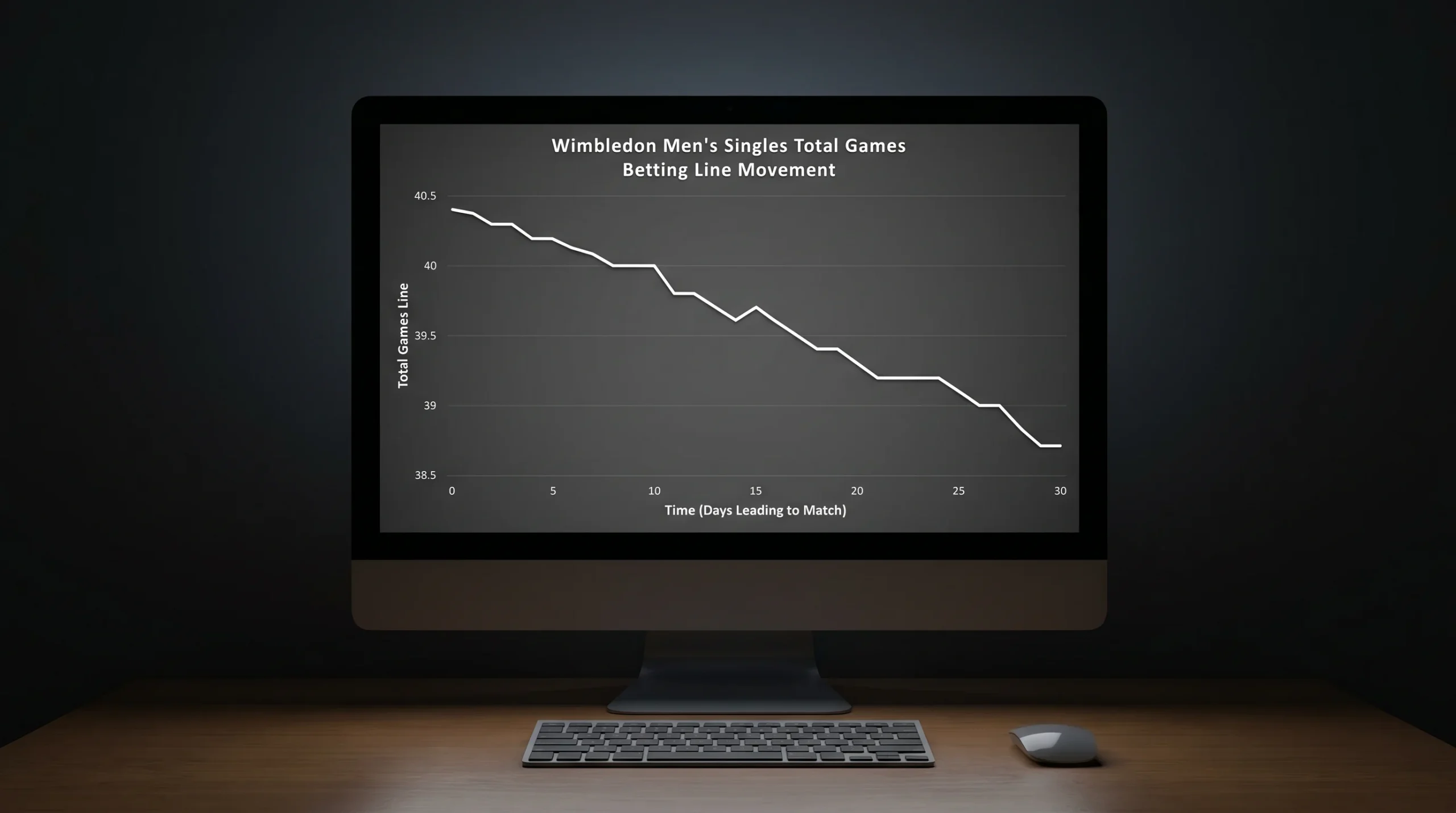
Weather is the other major line-mover for totals. Wind slows the serve, reduces first-serve percentages, and leads to more breaks — pushing totals up. Extreme heat (relevant at the Australian Open) can shorten matches if one player fades physically. Rain delays disrupt rhythm and can lengthen or shorten matches depending on which player handles the interruption better. None of these factors are priced into the opening line because they are uncertain at the time the line is set, which creates late-market opportunities for bettors who monitor conditions in real time.

The discipline with totals line movement is knowing when to act and when to wait. If the line moves in the direction you expected, you have lost value — the market has caught up with your analysis. If it moves against you, the question is whether the market knows something you do not or whether the movement is noise. After eleven years, I still get that judgment wrong about 30% of the time. The edge comes from getting it right more often than not, compounded across hundreds of bets.
Articles
Prepared by the bettennisonline.com editorial staff.
