
WTA Betting: Women’s Tour Patterns and Unique Market Dynamics
 Available in US
html
The conventional wisdom about WTA betting is that it is too unpredictable to be profitable. I spent four years believing that before I actually looked at the data and discovered the opposite: WTA markets are more volatile, which means they are more frequently mispriced, which means the edge is larger for anyone willing to do the work. The problem is not unpredictability — it is that most bettors mistake volatility for randomness. They are different things.
Forty percent of tennis bets on Entain’s platforms are placed on women’s events. That is a significant minority, but it means the women’s markets are thinner than the men’s, and thinner markets are less efficient. For analytical bettors, inefficiency is opportunity.

Contents
How WTA Markets Differ From ATP: Volume, Volatility and Value
The most important structural difference is the format. All WTA matches are best-of-three sets, including Grand Slam finals. This is not a minor detail — it fundamentally changes the probability distribution. In a best-of-three, a single dominant set can decide the match. A player who comes out firing in the first set and breaks serve twice might close out the match 6-2, 6-4 before the opponent has time to adjust. In the ATP’s best-of-five Grand Slam format, that same scenario plays out differently: the opponent has three more sets to recover, and the better player’s superior consistency usually reasserts itself.
The sixty-forty split between men’s and women’s betting volume has a direct consequence: WTA odds are set with wider margins because bookmakers face more uncertainty in pricing women’s matches. That wider margin means the overround is higher, which is a cost to bettors — but it also means the individual prices are less precisely calibrated, which is an opportunity. When the margin is 6% on a men’s match and 9% on a women’s match, the women’s match is more likely to contain a mispriced selection.
Volatility on the WTA is real and measurable. The top players change more frequently than on the ATP, with the number-one ranking changing hands more often per decade on the women’s tour. Rankings instability means the market’s primary pricing input — ranking differentials — is less reliable, which creates persistent opportunities for bettors who track form cycles more closely than the ranking algorithm does.
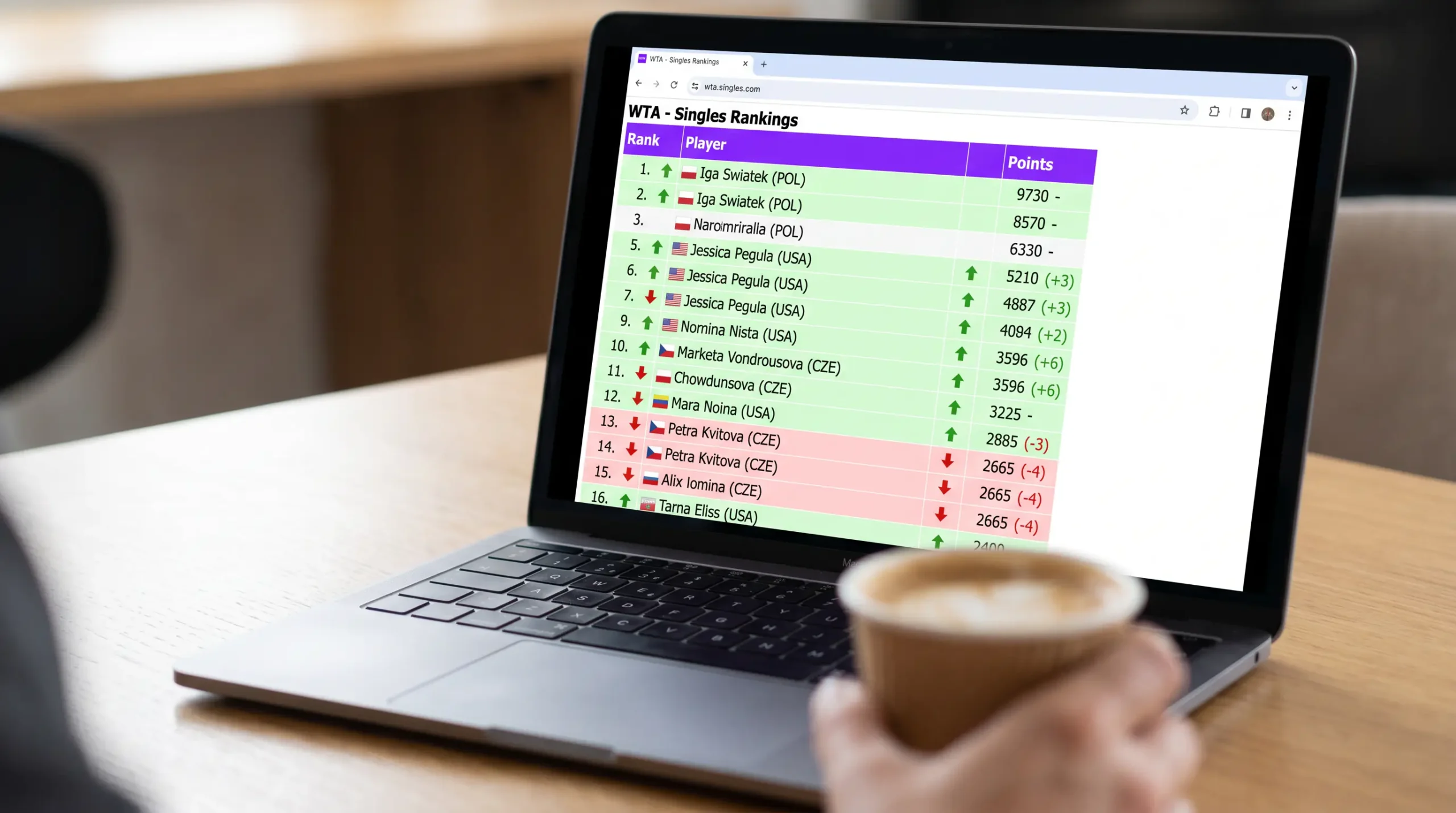
Best-of-Three and Higher Upset Frequency on the WTA
Clay-court tournaments produce about 15% more upsets than grass events, and the WTA amplifies that baseline upset rate across all surfaces because the shorter format gives less room for the favourite to recover from a bad start. The compounding effect is significant: a WTA clay-court event has the highest upset frequency of any combination of tour and surface. This is where most bettors lose money and where the sharpest bettors find it.
The mistake is treating every WTA upset as random noise. Many upsets follow identifiable patterns: a rising player ranked 30-60 who has been steadily improving meets a top-10 player coming off a tournament win (and the fatigue that comes with it) on a surface the lower-ranked player prefers. That is not random — it is a predictable setup, and the odds often do not reflect it because casual bettors see a top-10 name and assume safety.
I approach WTA upset potential by looking at serve-hold percentages on the specific surface over the previous 8-10 matches. If the favourite’s serve-hold rate has been declining — even slightly, from 80% to 72% — the probability of being broken increases disproportionately. In a best-of-three format, one extra break in the first set can cascade into a loss. That sensitivity to service data is what makes WTA betting analytically tractable despite its surface-level chaos.

Handicap markets on the WTA carry specific risk because the margin of victory is more variable. A player who wins 6-1, 6-2 in one match might win 7-6, 7-5 the next day against a similarly ranked opponent. That inconsistency makes game handicaps harder to price accurately and creates both risk and opportunity depending on your analytical framework.
WTA Calendar: Where the Overlooked Value Sits
The WTA calendar shares the same surface rotation as the ATP but with different tournament structures and different player behaviour patterns. The biggest divergence is in the mid-tier events — WTA 500 and WTA 250 tournaments — where the fields are less predictable because top players are more selective about scheduling.
That selectivity creates value at two specific points in the calendar. First, the January-February hard-court swing before the Australian Open, where the fields are uneven and form is uncertain. Second, the October-November indoor season, where top players either skip events entirely or compete with diminished intensity if they have secured their year-end ranking targets. In both windows, the market prices players off their annual ranking, but the reality on court is that motivation and fitness vary wildly.

The mid-season clay-to-grass transition that challenges ATP bettors is even more pronounced on the WTA. The grass-court season is shorter and the WTA has fewer grass events, which means most women’s players arrive at Wimbledon with minimal grass-court match play. This uncertainty inflates the upset probability and makes outright markets at Wimbledon wider than at any other WTA event. For outright betting specifically, Wimbledon on the women’s side is the most unpredictable and therefore potentially the most lucrative Grand Slam.

The WTA’s introduction of prize-money parity at Grand Slams has not translated into betting-volume parity, and the gap in market attention creates a structural advantage for bettors who pay the women’s tour as much analytical attention as the men’s. The patterns are different, the data requirements are different, but the edge is real for anyone willing to treat WTA betting as a discipline in its own right rather than as a footnote to ATP analysis.
Articles
Published by the bettennisonline.com team.
